Amine Unit
Corrosion Monitoring In Amine Unit
The importance of corrosion monitoring in amine units appears to have diminished over the last two decades. Several factors contribute to this trend. First, there has been a general shift toward upgrading metallurgy from carbon steel to stainless steel or higher alloys in the most critical areas, such as the hot lean outlet from the regenerator and the lean/rich exchanger. Second, the increased use of proprietary solvent mixtures with enhanced anti-corrosion properties and improved resistance to decomposition has played a significant role. Lastly, most corrosion damage in these systems is more often associated with localized amine stress corrosion cracking, flow-induced corrosion, or erosion-corrosion phenomena.
Amine Absorber
Refinery streams feeding the amine unit are typically rich in H₂S and should therefore be distinguished from, for example, upstream gas sweetening or carbon capture systems, which handle CO₂-rich streams.
The amine absorber section, including the absorber column, flash tank, and rich amine piping up to the rich/lean exchanger, typically does not exhibit severe amine corrosion. Rich amine is generally considered a relatively low-corrosive medium to carbon steel. In the presence of H₂S, the carbon steel surface is normally covered by a thin layer of FeₓSᵧ, which provides some level of corrosion protection. Unless the flow regime causes the removal of the FeₓSᵧ layer (due to high turbulence and elevated wall shear stress), carbon steel will corrode relatively slowly in rich amine stream. Therefore, it is less common to install corrosion monitoring in this section of the process unit.
If monitoring is required due to historical thickness loss in the rich amine stream, Ultrasonic Thickness Monitoring (UT) is preferred over intrusive methods. Electrical Resistance (ER) probes can provide incorrect readings (metal gain) due to the electrical properties of certain types of FeₓSᵧ. Linear Polarization Resistance (LPR) may also provide inaccurate readings, even with proper correction of the Stern-Geary parameter (B-value), due to strong electrode depolarization caused by FeₓSᵧ. An example of a UT monitoring location at the outlet of the rich amine pump is shown in Figure 1 as Location A.
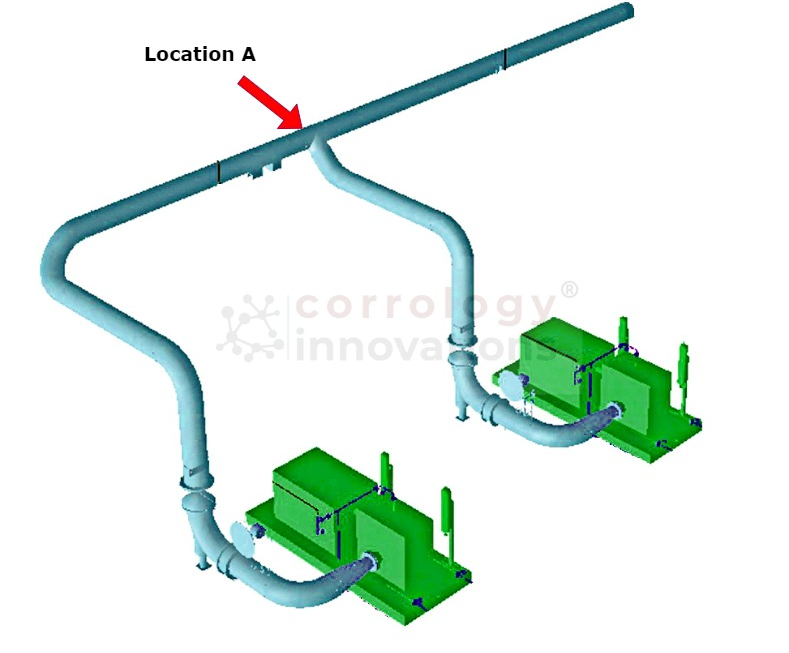
Figure 1 Example of UT Monitoring Location for Amine Unit - Rich Amine Pump Outlet.
Amine Regenerator
The regeneration section is more susceptible to amine corrosion compared to the absorber area, mainly due to the higher operating temperature (in the range of 100–140°C), low H₂S concentration (lean amine), which prevents the formation of a protective iron sulfide layer, the presence of multiphase flow at the reboiler outlet, and the likelihood of ammonium bisulfide corrosion in the overhead (OVHD) section.
Hence, corrosion monitoring is typically focused on a few key circuits within the regeneration section. The two most common locations are:
• The outlet from the regenerator reboiler • The OVHD piping
The outlet from the regenerator reboiler often experiences accelerated corrosion due to the multiphase flow (resulting in high wall shear stress) and potential instabilities in reboiler operations—usually caused by poor control of the heating steam flow and the likelihood of periodic overheating.
Corrosion monitoring should focus on areas with the highest turbulence—primarily the extrados of elbows in the hot amine return line to the regenerator, as shown in Figure 2 (location A).
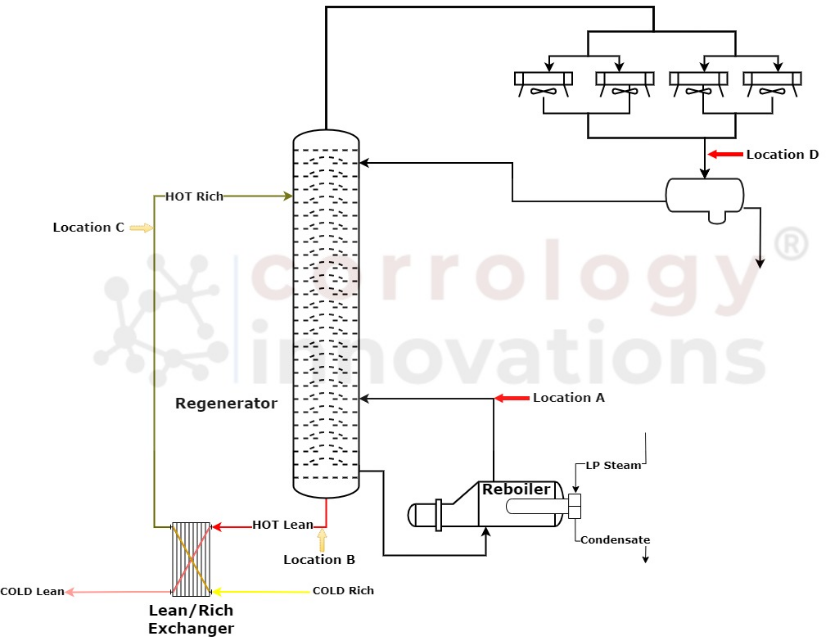
Figure 2 Amine unit – Amine regenerator section with typical corrosion monitoring locations.
On some occasions, when the hot lean amine piping from the regenerator bottom to the Lean/Rich exchanger is made of carbon steel, and the unit experiences issues with Heat Stable Amine Salts (HSAS) levels and amine over-stripping, corrosion monitoring may also be considered in this area (see Figure 2, Location B). Similar to the reboiler outlet, the user should identify areas with high wall shear stress and place monitoring there.
However, this location, along with monitoring at the hot-rich inlet (see Location C, Figure 2), is rarely utilized, mainly due to the widespread application of corrosion resistant alloys (e.g. stainless steels series 300) in these pipe sections. In the OVHD system, corrosion is most commonly observed downstream of the OVHD condensers, where alkaline sour water corrosion may occur.
Since most OVHD coolers in amine systems are now arranged in a balanced piping configuration (on both the inlet and outlet), it is sufficient to place corrosion monitoring on the main outlet line (see Figure 2, Location D), with a focus on areas of elevated turbulence. In the case of unbalanced piping, follow the same guidelines as outlined in the CDU OVHD chapter, paying particular attention to potential impingement in the main cooler outlet header.
Summary
A comprehensive summary of corrosion monitoring practices for Amine Unit is presented in Table 1. It outlines typical locations for monitoring, types of corrosion mechanisms addressed, and the recommended monitoring techniques.
Table 1 Summary of Amine Unit Corrosion Monitoring Techniques.
| Location | Typical CM Technique | Comments |
|---|---|---|
| Amine Absorber section – Cold Rich Amine Outlet | ||
| Coupons | - Coupons: not used in this section | |
| Electrical Resistance (ER) | • Rarely used due to issues with conductive FexSy deposits causing a ‘metal gain’ response. In CO2-amine systems, ER may be more useful • ER element: cylindrical (most common), optionally w/velocity shield • ER probe body: 316L • Typical access nozzle ID: 1 inch; 1.5 or 2 inch should be considered for easier retraction/ insertion System: retractable, Retractor Tool is required | |
| Linear Polarization Resistance (LPR) | • Not used in rich amine • In rich amine (in H2S systems) similar deficiency to ER – conductive FexSy cause electrode depolarization which leads to overestimation of corrosion rate which cannot be fully compensate by adjustment of Stern-Geary parameter (available in modern LPR systems). • In CO2 systems (e.g. carbon capture) LPR may be more useful 1 | |
| Ultrasonic Thickness Measurement (UT) | • Recommended, though rarely used due to the overall low corrosivity in this section of Amine unit - Low-temperature magnet sensors may be used, but high-temperature sensors (clamp mounted) are recommended • Installation should be preceded by a detailed UT scan of the line segment to identify areas with the greatest thickness losses and establish a baseline thickness Historical inspection data can be used, but for higher precision, it is recommended to perform a scan immediately before installation | |
| Amine regenerator – Reboiler Outlet | ||
| Coupons | • Coupons: not used in this section | |
| Electrical Resistance (ER) | • Possible application • ER element: flush (preferred), or tube w/velocity shield • Probe body material: 316L • Mounting: retractable system, Retractor Tool is required | |
| Ultrasonic Thickness Measurement (UT) | • Possible application. Due to typically localized metal loss, response from single point-UT may not be adequate for proper process-corrosion management, hence, multi-sensors UT-systems are recommended • HT-sensors mounted with clamps or welded studs recommended | |
| Linear Polarization Resistance (LPR) | • Modern LPR systems w/Stern-Geary correction (B-value) proved to be useful in this system. 2, 3 • Electrodes: flush (recommended) or finger w/velocity shield • Mounting: retractable system, Retractor Tool is required | |
| Amine regenerator – OVHD | ||
| Coupons | • Possible application, however, rarely used due to relatively low stream corrosivity and requirements for long exposition (min 30 days) • Mounting: retractable, Retractor Tool is required • Insertion rod: 316L • Disc coupons recommended | |
| Linear Polarization Resistance (LPR) | • Modern LPR systems w/Stern-Geary correction (B-value) may be used in this location • Finger electrodes w/velocity shield or flush-electrodes • Probe body: 316L • Mounting: retractable, Retractor Tool is required | |
| Electrical Resistance (ER) | • Possible application however for H2S systems not recommended due to highlighted earlier problems with conductive FexSy deposits • Relatively low corrosion rate may require a thin sensing element which reduces the effective service life of the ER probe • Mounting: retractable, Retractor Tool is required • Probe body: 316L • Sensing element: flush or cylindrical (w/velocity shield) | |
| Ultrasonic Thickness Measurement (UT) | • Possible application • Magnet mounting sensors can be used but for 3-6inch pipelines clamp-mounting is recommended • High Temperature (HT) sensors recommended • Multi-sensor systems are preferred over single-point sensor | |
| Amine regenerator - HOT Lean Outlet | ||
| Linear Polarization Resistance (LPR) | • Modern LPR systems w/Stern-Geary correction (B-value) may be used in this location • Finger electrodes w/velocity shield or flush-electrodes • Probe body: 316L • Mounting: retractable, Retractor Tool is required | |
| Ultrasonic Thickness Measurement (UT) | • Possible location • High Temperature (HT) sensors, clamp mounted recommended • Multi-sensor systems are preferred over single-point sensor | |
| Amine regenerator - HOT Rich Inlet | ||
| Electrical Resistance (ER) | • Not recommended due to the deposition issues mentioned earlier. In CO2-amine systems, ER may prove useful • Mounting: retractable, Retractor Tool is required • Probe body: 316L • Sensing element: cylindrical w/velocity shield | |
| Ultrasonic Thickness Measurement (UT) | • Possible location • High Temperature (HT) sensors, clamp mounted recommended • Multi-sensor systems are preferred over single-point sensors | |
| Coupons and LPR | • Not commonly used in this location |
References
This Article has 3 references.
1:R.D. Kane, S. Srinivasan, P. Khakharia, E. Goetheer, J. Mertens - Applications of Online Corrosion Monitoring: CO2 Capture Amine Plant Case Study - NACE Corrosion Conference 2015, paper no, 5954
2:J. Bulger, M. Girgis, T. Polvi - Corrosion Due to Process Instability in a Hot Lean Amine System - NACE Corrosion Conference 2005, paper no. 05386
3:P. Quiroga, R.D. Kane, M. Castillo, V. Lagad - Improving Amine Unit Reliability with On-line Corrosion Monitoring & Modeling - NACE Corrosion Conference 2008, paper no. 08421
Contact Us
For more details on corrosion monitoring solutions, feel free to contact us.
Our experts are ready to assist with your specific needs