Hydroprocessing
Corrosion Monitoring Hydroprocessing (hydrotreating/hydrocracking)
Corrosion monitoring in hydroprocessing units (such as hydrotreating and hydrocracking) is relatively uncommon. The core processes, hydrogenation and/or cracking, occur in a water-free environment at elevated temperatures, making typical uniform electrochemical corrosion unlikely. Corrosion generally takes place in the cooling-separation section of the unit and is often driven by the presence of alkaline sour water (ammonium bisulfide solution).
Common areas of corrosion include the reactor effluent air-cooler (REAC), sour water lines from cold separators, product strippers/stabilizers and fractionation. Even so, corrosion monitoring is not always recommended by process licensors, as proper design and material selection effectively mitigate the risks of elevated corrosiveness. When the concentrations of sulfur, nitrogen, and oxygenates in the hydroprocessing feed exceed the original design conditions, whether due to bio-feed co-processing or the use of high-sulfur side-cuts, corrosion can intensify and demanding stricter monitoring.
Feed preheat section
Typically, the metallurgy used in the feed pre-heat section—such as alloyed steels like 5Cr-0.5Mo or 9Cr-1Mo in high-temperature areas—provides sufficient corrosion protection. The generally low rate of corrosion in these sections often makes on-line corrosion monitoring economically impractical.
However, when the feed contains elevated sulfur levels, the process environment can become more aggressive, accelerating the sulfidation process. In these instances, on-line monitoring may become a reliable and cost-effective solution. Given the pressure and temperature conditions, the preferred monitoring method is Ultrasonic Thickness (UT) Monitoring with multiple sensors installed in the hottest pipeline sections (typically after the furnace).
Reactor Section
The hydrotreating or hydrocracking reactor is usually constructed from alloyed steels (1.25Cr, 2.25Cr etc.), with internal cladding made of 300-series austenitic stainless steels (e.g., 347). In this material configuration, uniform corrosion is unlikely, giving way to localized hydrogen-driven cracking phenomena and/or high-temperature damage caused by metallurgical changes (e.g., temper embrittlement). To assess the impact of hydrogen and the likelihood of hydrogen embrittlement, hydrogen flux probes (typically welded to the shell) are sometimes utilized. However, this form of monitoring is rare, as interpreting hydrogen flux data is not a straightforward process.
Reactor Effluent Coolers (REAC)
Ammonium bisulfide is a primary corrosion driver in effluent coolers and downstream equipment (separators). Proper mechanical design of the REAC (balanced piping at the inlet and outlet) and carefully selected operating conditions (such as avoiding high concentrations of NH4HS, reducing cyanide, and implementing efficient water washing, etc.) are, in most cases, sufficient to mitigate corrosion of carbon steel. Exceeding the design conditions, such as increasing H₂S partial pressure (H₂S pp) and NH₃ partial pressure (NH₃ pp) at the reactor’s outlet due to processing feed with elevated sulfur and nitrogen content, will increase the concentration of ammonium bisulfide. This will require a higher wash water rate, and the resulting excessive turbulence will accelerate sour water corrosion.
Intrusive corrosion monitoring is occasionally used, utilizing modern LPR (Linear Polarization Resistance) technologies with the capability to compensate for FeS electrode depolarization by determining the system-specific Stern-Geary constant (B). Probes are typically placed at the common outlet of the REAC system (refer to Figure 1, Location A).
Since most corrosion damage downstream of the REAC occurs in areas with elevated turbulence (high wall shear stress), UT (ultrasonic testing) systems with multiple sensors may also provide a good view in corrosion projections. However, the installation of UT sensors should be preceded by thorough flow modeling to identify areas with the highest wall shear stress and the potential for the highest corrosion rates. The most typical locations are shown in Figure 1 at points B and B’.
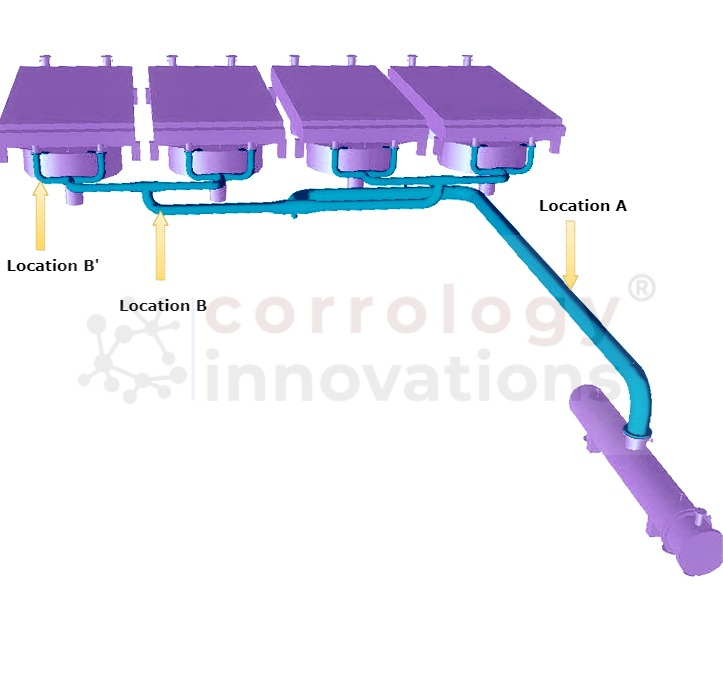
Figure 1 Hydroprocessing - REAC - potential corrosion monitoring locations marked by arrows.
Product stripping and fractionation
After sour water separation, the hydrocarbon stream is generally considered non-corrosive. However, depending on the specific process configuration, if an additional product stabilizer/stripper is used, elevated corrosion may occur in the overhead (OVHD) section of the product stripper. Consequently, though rare, corrosion probes may be installed at the inlet and outlet of the stripper’s OVHD condensers. Electrical resistance probes are the preferred choice, as the very low water content (if any) makes LPR systems non-functional.
In the main fractionator section, general corrosion driven by electrochemical reactions is unlikely, so corrosion monitoring is typically not implemented in this process area.
Summary
A comprehensive summary of corrosion monitoring practices for Hydroprocessing is presented in Table 1. This table outlines typical locations for monitoring, and the recommended monitoring techniques for each unit.
Table 1 Hydroprocessing Unit (hydrotreating/hydrocracking) corrosion monitoring techniques summary.
| Location | Typical CM Technique | Comments |
|---|---|---|
| Feed Pre-Heat | ||
| UT | • Preferable over intrusive methods. • Clamp mounting recommended. • High Temperature sensor (>200°C), recommended. | |
| ER | • Rarely used. • High temperature probe configuration required. • A retractable system should be used – suitable for process pressure up to 100bar. For processes with pressure above 100bar, non-intrusive systems (UT) should be preferential. • Preferable mounting: 2” flange (class based on line pressure rating). •Probe body: 316L • Element: cylindrical w/velocity shield | |
| Reactor | ||
| Hydrogen Probe | • Rarely used. • Data analysis is complex. • Non-intrusive H-probe system preferable due to cladding systems in reactor shell | |
| Reactor Effluent Air Cooler - REAC | ||
| LPR | • Modern LPR systems have proven effective in monitoring alkaline sour water corrosion. • Electrodes: finger with velocity shield • Probe body: 316L • Retractable (up to approximately 100 bar) mounted on a flanged access nozzle. Retrievable systems, while suitable for higher pressures, may be susceptible to leaks due to threaded connections that are sensitive to pipe vibrations | |
| ER | • Use with caution due to issues with conductive FexSy deposits. • Mounting: same as for LPR • Probe body: 316L • Element: cylindrical w/velocity shield | |
| UT | • There is a growing preference for these systems over intrusive methods. • High-temperature sensors, clamp mounted recommended. | |
| Stripping/Fractionation | ||
| ER | • Due to overall low corrosion thin sensing element may be required. • Mounting, probe body, and sensing element: similar to the REAC system. | |
| UT | • Rarely used due to overall low corrosion in this section. |
Contact Us
For more details on corrosion monitoring solutions, feel free to contact us.
Our experts are ready to assist with your specific needs