Sour Water Stripping
Corrosion Monitoring In Sour Water Stripping (SWS) Unit
Ammonium bisulfide corrosion (also known as alkaline sour water corrosion) is the primary damage mechanism and occurs in almost all parts of the SWS unit. However, its intensification is typically observed in the stripper’s overhead (OVHD) line and coolers, and rarely in the hot sour water (SW) feed line. In the stripper reboiler loop (if a reboiler is present), alkaline sour water corrosion is a rare phenomenon but may still occur depending on the unit’s operating regime and loading. Hot stripped sour water and cold sour water feed do not pose a serious corrosion threat.
Stripper OVHD
H₂S, NH₃, and water vapors leaving the top of the stripper create a natural environment for ammonium bisulfide corrosion. In the condensation area, where liquid water is present and the pH (ranging from 9 to 10) favors the stability of the HS⁻ ion, sour water corrosion is likely. Therefore, corrosion probes should be located in these areas.
If a corrosion inhibitor is injected into the overhead (OVHD) line, the probes should be installed downstream of any injection systems, as shown in Figure 1. Depending on inlet piping configuration and access Locations A and/or A’ may be considered for corrosion monitoring.

Figure 1 Sour Water Stripper OVHD system – potential locations for corrosion monitoring.
Due to the presence of H₂S-rich fluid and multi-phase flow, both intrusive LPR and ER systems should be used with caution. Both systems are susceptible to FeS deposition on the electrode or sensing element, which can lead to depolarization and result in a very high corrosion rate in the first case, or metal gain in the second case, respectively.
Ultrasonic thickness measurement can also be a suitable method for monitoring corrosion in this particular SWS circuit. As with any UT system, the selection of the transducer location should be preceded by a detailed scan of the relevant pipe segment, supported by historical inspection findings
OVHD separator
Similar to CDU OVHD systems, also in SWS OVHD, corrosion monitoring is sometimes located at the sour water outlet from overhead separator. It is not a common solution, as typically water from the separator’s boot should not be highly corrosive. Location of corrosion monitoring points should focus mostly on turbulence-causing points like elbows or tees – see Figure 2 for reference.
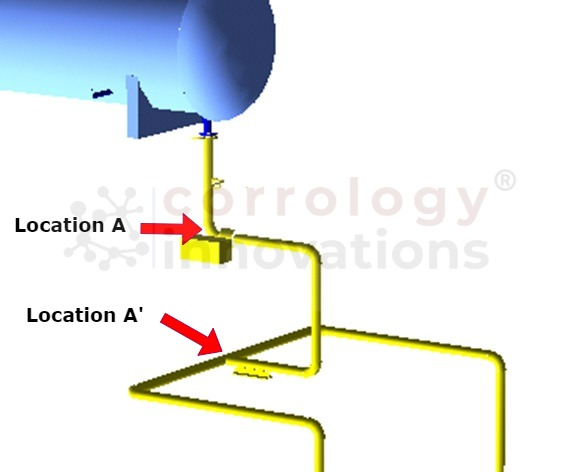
Figure 2 OVHD separator outlet – potential locations for corrosion monitoring points.
LPR probe is best fitted monitoring technology for outlet from SWS OVHD separator.
Stripper - Reboiler
Typically, a low corrosion rate is expected in the stripper-reboiler loop, and as a result, corrosion monitoring is generally not planned or designed for this section. However, during unstable operation of the SWS unit, such as overloading, there may be potential for elevated corrosion. In this scenario, corrosion monitoring in the reboiler return line could be warranted.
An LPR system with a velocity shield or ultrasonic thickness (UT) monitoring, located as shown in Figure 3, may be considered. An ER system can also be utilized; however, due to its longer response time, the LPR system, with a minute-based response, is better suited for this application.

Figure 3 Stripper-reboiler (vertical) loop and potential location for corrosion monitoring.
Summary
A summary of corrosion monitoring practices for Sour Water Stripping Unit is presented in Table 1. This table outlines typical locations for monitoring, and the recommended monitoring techniques for each unit’s areas.
Table 1 Sour Water Stripping Unit corrosion monitoring techniques summary.
| Location | Typical CM Technique | Comments |
|---|---|---|
| Stripper OVHD | ||
| UT | • Preferable over intrusive methods. • Clamp mounting recommended. • High Temperature sensor (>200°C), recommended. | |
| LPR | • Modern LPR systems have proven effective in monitoring alkaline sour water corrosion. • Electrodes: flush – to be used with caution due to potential FeS deposition. • Probe body: 316L • Retractable (up to approximately 100 bar) mounted on a flanged access nozzle. | |
| ER | • Commonly used – caution required due to presence of conductive FeS deposit causing metal gain. • A retractable system should be used – suitable for process pressure up to 100bar. • Preferable mounting: 2” flange. • Probe body: 316L • Element: cylindrical w/velocity shield | |
| OVHD Separator Outlet | ||
| UT | • Alternative to LPR. • Clamp mounting recommended. • High Temperature sensor (>200°C), recommended | |
| LPR | • Modern LPR systems have proven effective in monitoring alkaline sour water corrosion. • Electrodes: finger – velocity shield is not required due to low flow velocity. • Probe body: 316L • Retractable (up to approximately 100 bar) mounted on a flanged access nozzle. | |
| ER | • Least favorable – caution required due to presence of conductive FeS deposit causing metal gain. • A retractable system should be used – suitable for process pressure up to 100bar. • Preferable mounting: 2” flange. • Probe body: 316L • Element: cylindrical – velocity shield not required | |
| Stripper - Reboiler | ||
| LPR | • LPR is the best fitted to this location. • Electrodes: finger with mandatory velocity shield • Probe body: 316L • Retractable (up to approximately 100 bar) mounted on a flanged access nozzle | |
| ER | • Used alternatively to LPR but not favorable due to longer response time. • Mounting: same as for LPR • Probe body: 316L • Element: cylindrical w/velocity shield | |
| UT | • Potential location for UT sensor. • High-temperature sensors, clamp mounted recommended |
Contact Us
For more details on corrosion monitoring solutions, feel free to contact us.
Our experts are ready to assist with your specific needs