Corrosion coupons
General Info
The exposure of corrosion coupons is one of the oldest techniques for corrosion monitoring and, despite several drawbacks, it remains popular and widely used in various applications.
In the refining industry, coupons are mostly used in cooling water systems and overhead (OVHD) systems in crude distillation. Sometime they can also be used in amine units (various locations on rich and lean amine and regenerator OVHD), sour water (SW) strippers (mostly stripper OVHD), and other applications where multiphase, condensing systems with potential for deposition are encountered.
Installation
- Disc-type coupons installed on 2 inch flanged access nozzles are most commonly used in process units. Typical flange and coupon holder with disc coupons is shown on Figure 1.
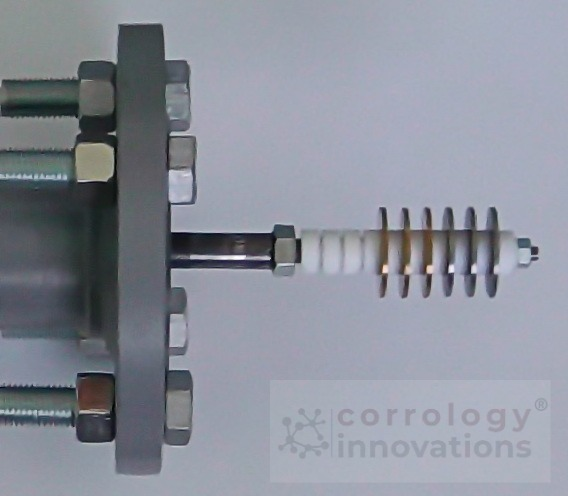
Figure 1 Typical arrangement for disc coupons mounted using 2”150# flange.
- Flat strip coupons are commonly integrated with ER or LPR probes (see Figure 2); however, extra caution is needed during insertion to prevent the coupon from bending. Flat strip coupons mounted on the top of an ER or LPR probe can be installed only on pipelines with a minimum ID of 5–6 inches. The strip coupon and probe sensing element have a minimum length of 4–4.5 inches, depending on the type of sensing element or electrode, leaving no more than 1–2 inches of free space (see Figure 2 for an example). This setup assumes that both the coupon and the probe sensing element are fully exposed to the process stream.
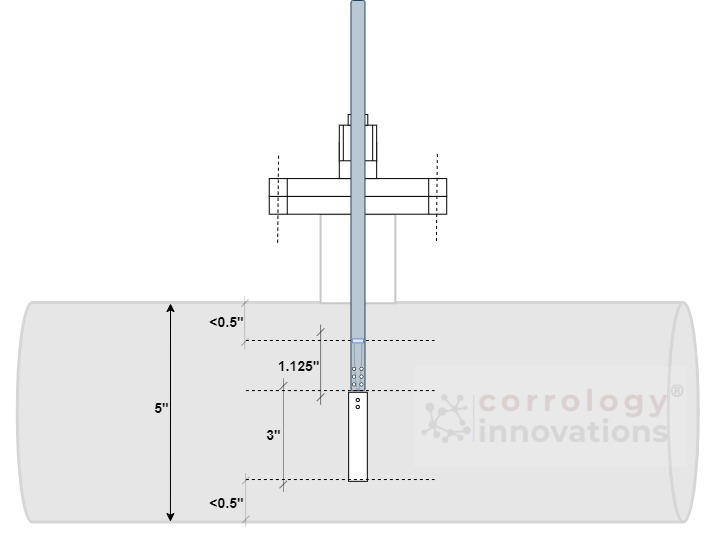
Figure 2 Example of 3” strip coupon exposed in 5” pipeline – desirable insertion depth.
Incorrect calculation of the maximum insertion length can result in strip coupon deformation (see Figure 3).
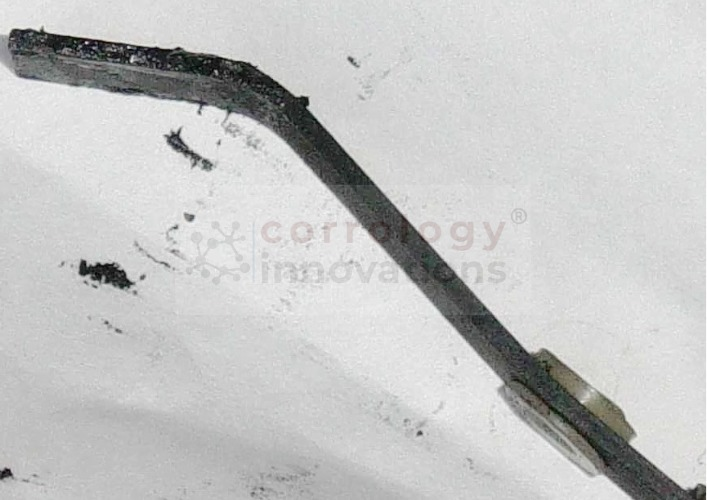
Figure 3 Example of a deformed strip coupon.
The coupon holder with disc coupons in horizontal pipelines shall be positioned at the 9 o’clock orientation to prevent corrosion products from falling and accumulating on lower specimens.
Wake frequency calculations may be performed to ensure safe oscillation regimes.
As a general rule, the coupon material should match the material of the pipeline or equipment under consideration.2 However, for carbon steel coupons, the most common and cost-effective approach is to use mild carbon steel, preferably UNS G10100 (AISI 1010) or UNS G10180 (AISI 1018). It is commonly believed that mild steel may corrode faster than pipe-grade material, thus representing a worst-case scenario. In reality, the corrosion rate of mild carbon steel is not significantly different from typical pipe-grade steel, and any potential differences, if present, are usually within the margin of measurement error. Therefore, using mild carbon steel instead of dedicated pipe-grade material is generally preferable.
Another important factor is the surface finish, which can either somewhat accelerate (e.g. coarse finish) or reduce (e.g. mirror finish) the corrosion rate. It is widely accepted that coupons with a surface roughness of 120 grit are the best fit for use in typical industrial applications
Exposition time
- There are no strict rules for determining coupon exposure time. However, some industry guidelines provide an estimation for exposure time based on the following formula:1
Texp (hours) = 50 / Corrosion rate in mm/y
or
Texp (hours) = 2000 / Corrosion rate in mpy
Assuming a corrosion rate in the range of 0.1-0.2 mm/y, the exposure time would be between 20 and 10 days, respectively. However, most refiners take a more universal approach, opting for a 30-day coupon exposure period. This strikes a balance between the effectiveness of corrosion measurement and the effort involved in removal, insertion, and analysis. For low-corrosive environments (<0.05 mm/y), the exposure time needs to be at least 50-60 days or longer, which reduces the responsiveness of corrosion monitoring to actual corrosion events.
Coupon Analysis
Coupon corrosion monitoring provides a unique opportunity to collect detailed information about the corrosion process in a given stream. Parameters such as deposition rate, scale composition and morphology, pit density, and pit depth can be measured using corrosion coupons.
It is, however, important to highlight that the accuracy of coupon corrosion measurement may vary between +/- 20% to +/- 50% of the mean.2 Therefore, it is recommended to use a minimum of three coupons exposed in a single batch to allow for at least basic statistical analysis to be applied. Single-coupon exposure and analysis can lead to inaccurate or misleading conclusions. It is also important to follow specific cleaning procedures according to established standards and regulations.1
References
This Article has 2 references.
1:ASTM-G1- “Standard Guide for Conducting Corrosion Tests in Field Applications”-latest ed., ASTM International, West Conshohocken, PA, United States
2:2. ASTM-G4-“ Standard Guide for Conducting Corrosion Tests in Field Applications”, latest ed., ASTM International, West Conshohocken, PA, United States
Contact Us
For more details on corrosion monitoring solutions, feel free to contact us.
Our experts are ready to assist with your specific needs