Electrical resistance (ER)
General Info
Electrical Resistance (ER), along with corrosion coupons, is one of the oldest industrial corrosion monitoring techniques. However, the popularity of ER systems has diminished over the last decades in favor of non-intrusive, online ultrasonic thickness monitoring (UT). Nevertheless, ER still possesses certain advantages and, when used properly, can provide accurate and reliable information about process stream corrosivity.
Installation
- Similar to LPR, the retractable system is also the most popular solution for installing ER probes in refining environments. The recommended mounting system consists a flange connection (see Figure 1). Threaded probe mounting, often using a 1" NPT nozzle, is not always recommended, as vibrations from process pipes or equipment can loosen the threaded connection .
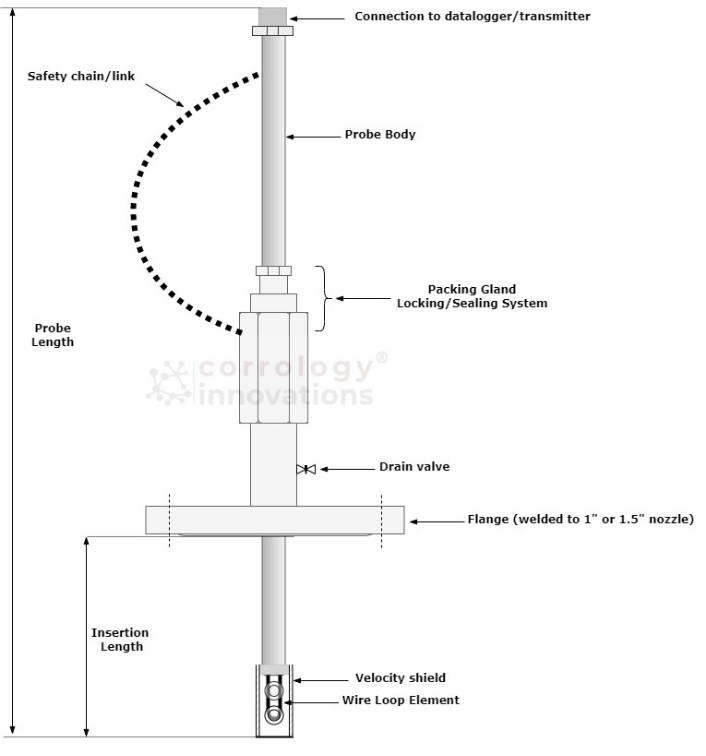
Figure 1 Generic drawing of retractable ER probe with flange connection.
Wake frequency calculations are recommended, especially for probes longer than 24 inches.
Proper selection of ER sensing element (see Figure 2) is a key-element in obtaining a reasonable response time without excessively shortened service life.

Figure 2 Schematic drawings of the most popular ER sensing elements.
Selection of ER sensing element is a relatively simple process but requires some basic information about corrosivity and operating parameters of the process where it will be used. The following guideline shows simplified way for selection of proper ER sensing element:
- for low corrosive service (<0.1mm/y or 4mpy) and low temperature (c.a. <100°C / 212°F): use thin (small) Flush type elements,
- for environment that could impact epoxy sealant of flush type element – use Tube Loop elements with glass seal, - consider velocity shield as mandatory requirement for Tube Loop type element,
- for moderate corrosive service (0.1-0.25mm/y or 4-10mpy), and low temperature (c.a. <100°C / 212°F) use thick (large) Flush or Cylindrical element, for turbulent system Cylindrical element requires velocity shield,
- for moderate corrosive service but at high temperature, use Cylindrical element,
- for severe corrosive service (c.a. >0.25mm/y or 10mpy), use Cylindrical or Wire Loop elements; Wire Loop always requires velocity shield,
- after selection of sensing element type, its thickness will be governed by combination of expected corrosion rate and meaningful response time – for details please refer to Figure 3
Figure 3 Example correlation of response time and service life of various sensing elements at different corrosion rates.after 2
For assistance in selection of proper sensing element please contact us here.
Materials
The ER probe body is fabricated from corrosion-resistant alloys, typically 316L (UNS S31603) stainless steel, which is suitable for most applications. Austenitic stainless steel should be avoided in processes where chloride-containing deposits and HCl-driven under-deposit corrosion are present. In such cases, the probe body should be made of alloy C-276 (UNS N10276).
Ideally, the material of sensing element should match that of the pipe or equipment on which corrosion is being measured. However, as with corrosion coupons and LPR electrodes, significant differences in corrosion rates are not expected between mild carbon steel—typically UNS G10180 (AISI 1018)—and standard pipe-grade steels like ASTM A106 Grade B. Therefore, mild steel is often a preferred, cost-saving choice for ER sensing element over pipe-grade steels.
Flush-type sensing elements are mounted/sealed using various epoxy compounds. Hence, it is important to check the chemical compatibility of the used epoxy sealant with the process components, especially when the probe will operate at temperatures of 100°C / 212°F or higher.
In systems with heavy deposition, flush-type elements should be the preferred option over wire, tube, or cylindrical systems, which require a velocity shield that may act as a ‘strainer’ and lead to rapid blockage of flow through the shield. See Figure 4 for an example of a sensing element blocked by wax-type deposits.

Figure 4 Example of velocity shield with Wire Loop element (right) and after service (left) with wax-type deposits blocking the shield.
Operation
The ER systems can operate in virtually any environment. However, special attention should be given when using ER probes in high-H₂S services (e.g., amine stripper overhead) and/or in environments with a high propensity for fouling or deposition (e.g., CDU OVHD).
In the case of high H₂S, the ER technology may encounter a phenomenon known as ‘metal gain.’ This occurs due to the electrical properties of certain forms of iron sulfide, which, when deposited on the sensing element, can mask metal loss or even falsely indicate an increase in the element’s thickness.
In the second case, when the sensing element is covered by hydrocarbon-type deposits, these deposits may form a barrier that effectively protects the sensing element from the corrosive environment. In some instances, this does not necessarily indicate incorrect operation, as the sensing element may reasonably reflect the actual conditions on the pipe wall—especially when using a flush-type element.
The output from the ER system is the thickness of the sensing element, expressed in millimeters or mils. To obtain a corrosion rate expressed in mm/year (mm/y) or mils per year (mpy), the thickness (or metal loss) data needs to be integrated over fixed time periods, which may cause some confusion in ER data analysis. If the integration period is improperly selected (either too long or too short), the resulting corrosion rate may be overestimated or underestimated.
It is recommended to have at least two trends or calculations of the corrosion rate for short time frames (ranging from 1 day to a maximum of 14 days) and long-time frames (from 14 to 30 days). It is important to select the appropriate integration time that takes into account the observed corrosion rate, the ER response time and data logging rate (e.g., every hour, every 12 hours, etc.), as well as the frequency of fluctuations or changes in process parameters.
Verification of the integration time and data logging frequency should be conducted at regular intervals—typically once per year or after any major changes in process conditions that could trigger a meaningful change in the corrosion rate.
Retractable system is designed for process with pressure less than 100 barg and is one of the most commonly used intrusive system in the refining industry. When operated properly, with a probe-to-process seal, using PTFE or other sealants such as Grafoil1 it can practically guarantee a complete seal between the probe and the process, up to approximately 100 barg.
The retrievable system, commonly used in high-pressure applications (»100 barg) within the upstream segment of the oil and gas industry, is generally not recommended for use in the refining industry. Operating a retrievable system is complex and requires highly skilled and experienced technical personnel. Additionally, due to the need for specialized equipment (such as a safety valve and retrieval tool), a retrievable system is typically twice as costly as a retractable one. Although it may appear more robust and safer than a retractable system, the retrievable system actually may present greater safety concerns, particularly during the retrieval and insertion processes.
A retractable system provides a high level of flexibility with regard to the probe’s insertion depth, which can be easily adjusted as needed. In contrast, the insertion length of a retrievable probe is typically fixed and must therefore be carefully estimated based on the existing process connection. Some probe suppliers offer optional capabilities for small adjustments to the probe’s length, though these are usually limited.
Contact Us
For more details on corrosion monitoring solutions, feel free to contact us.
Our experts are ready to assist with your specific needs
- 1 - Grafoil® is a registered trademark of NeoGraf Solutions.
- 2 - https://www.alspi.com/erintro.htm.