Linear Polarization Resistance (LPR)
General Info
Linear Polarization Resistance (LPR) is a technique that provides near real-time corrosion measurements. Modern LPR technologies, which often incorporate additional electrochemical techniques (e.g., Harmonic Distortion Analysis or Electrochemical Noise) within a single instrument, can provide accurate monitoring not only in traditionally LPR-applicable systems like cooling water but also in more challenging environments such as sour water, lean amine, and even condensing overhead (OVHD). These modern LPR systems allow for measurement intervals as short as minutes, making it well-suited for online process-corrosion correlation.
Installation
- The retractable system is the most popular solution for installing LPR probes in refining environments. The recommended mounting system consists of a 1-inch access nozzle with a flange connection (see Figure 1). Threaded probe mounting, often using a 1" NPT nozzle, is not always recommended, as vibrations from process pipes or equipment can loosen the threaded connection.
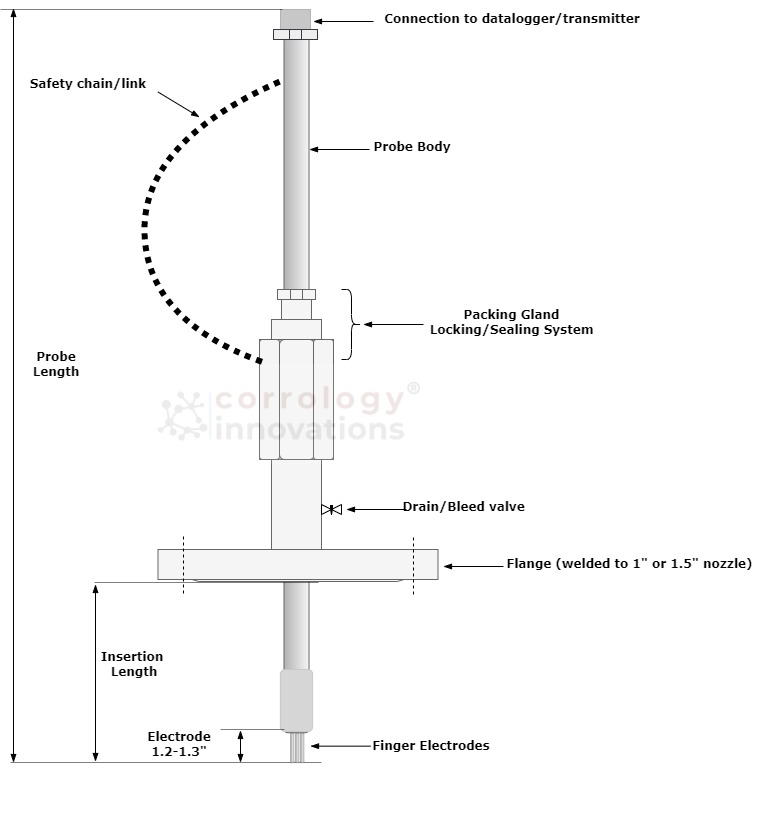
Figure 1 Schematic drawing of retractable LPR probe with flange connection.
- Wake frequency calculations are advised, with particular attention to the oscillation of the electrodes. Since the electrodes are seated on soft O-rings, improper mounting on the probe tips can cause them to oscillate at a different amplitude than the probe body, potentially leading to tip breakage. See Figure 2 for reference.
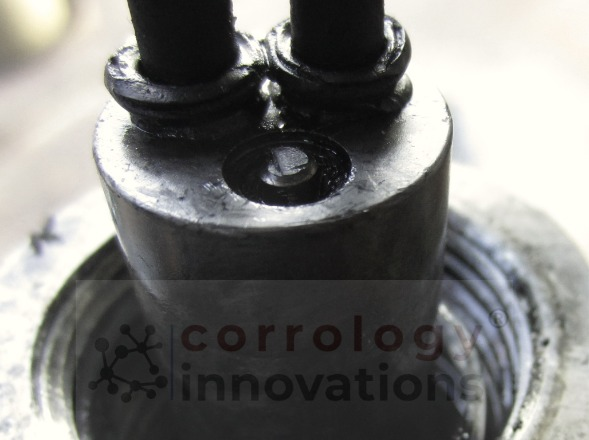
Figure 2 Example of broken electrode mounting tip due to incorrect o-ring installation (double o-rings).
- LPR probes, like any other intrusive systems, should be installed at the 12 o’clock position on horizontal pipe segments. This orientation helps prevent the accumulation of solids and sediments between the electrodes. Orientations at the 9 o’clock and 6 o’clock positions are not recommended and should be avoided, even in virtually clean water streams.
Materials, service life
The LPR probe body is fabricated from corrosion-resistant alloys, typically 316L (UNS S31603) stainless steel, which is suitable for most applications. Austenitic stainless steel should be avoided in processes where chloride-containing deposits and HCl-driven under-deposit corrosion are present. In such cases, the probe body should be made of alloy C-276 (UNS N10276).
Ideally, the electrode material should match that of the pipe or equipment on which corrosion is being measured. However, as with corrosion coupons, significant differences in corrosion rates are not expected between mild carbon steel—typically UNS G10180 (AISI 1018)—and standard pipe-grade steels like ASTM A106 Grade B. Therefore, mild steel is often a preferred choice for electrodes over pipe-grade steels, as it provides a more cost-effective solution for LPR corrosion monitoring.
In the context of fabrication, it is generally agreed that the electrode surface roughness should be maintained within the range of about 0.2 to 0.4 micrometers.
Proper selection of the O-ring material is one of the key elements that ensure the long-term, fault-free operation of the LPR system. The most commonly used O-ring materials are fluorinated elastomers (e.g., DuPont™ Viton®1) or, for harsher environments, perfluorinated elastomers (e.g., DuPont™ Kalrez®2). In high-temperature conditions (>100°C / >212°F) and in fluids containing ammonia or amines, these O-ring materials may not guarantee long-term performance – see Figure 3. Therefore, it is recommended to use Teflon®3.
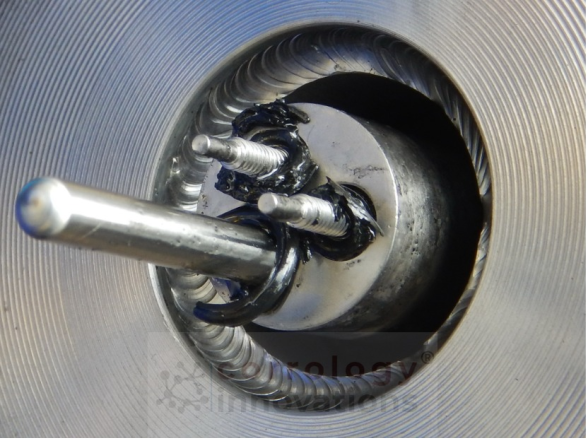
Figure 3 Example of damaged electrode o-rings in ammonia/amine containing service.
- The service life of electrodes depends on the overall corrosivity of the process stream and can be estimated similarly to the life of the ER sensing element. This estimation involves dividing the useful electrode wall thickness (most commonly about 50 mils / 1.25 mm—to maintain some margin for mechanical integrity) by the average corrosion rate, e.g., 50 mils / 4 mpy = 12.5 years. However, in reality, the service life of electrodes is shorter due to crevice corrosion that occurs beneath the O-rings. Therefore, the typical service life of electrodes in low to moderate corrosive environments (4-8 mpy / 0.1-0.2 mm/y) and low deposition may be estimated to be between 2 and 4 years
Contact Us
For more details on corrosion monitoring solutions, feel free to contact us.
Our experts are ready to assist with your specific needs
- 1 - DuPont™ Viton® is a registered trademark of E.I. du Pont de Nemours and Company or its affiliates
- 2 - DuPont™ Kalrez® is a registered trademark of E.I. du Pont de Nemours and Company or its affiliates
- 3 - Teflon® is a registered trademark of Chemours