Carburization
General Information
Carburization is a form of metallurgical failure/degradation commonly observed in environments containing carbon at elevated temperatures. This type of degradation is frequently associated with metals and alloys exposed to carburizing conditions, where carbon diffuses into the material at high temperatures, leading to the formation of carbides.1 This process can compromise the material’s mechanical properties and structural integrity. Furthermore, it may escalate to metal dusting, particularly when carbon activity exceeds unity, resulting in highly localized carburization and causing catastrophic damage.2 4 Carburized steel tends to become brittle and may exhibit spalling or cracking .2 Notably, carburization is of significant concern in industries such as refining, petrochemicals, and power generation.
The process of carburization typically involves the following:
- Elevated Temperatures: Carburization occurs at elevated temperatures, typically above 593°C (1100°F) and often even higher depending on the specific materials and conditions.
- Carburizing Environment: The presence of carbon-rich atmospheres, such as hydrocarbons or carbon monoxide, is a key factor.
- Diffusion of Carbon: At elevated temperatures, carbon atoms from the carbon-rich atmosphere diffuse into the surface of the metal. This diffusion is a function of temperature and time, and it causes an increase in carbon concentration at the material’s surface.
- Carbide Formation: The diffused carbon reacts with alloying elements in the metal to form carbides. Common carbide-forming elements include chromium, tungsten, and molybdenum. These carbides are hard and brittle compounds that can reduce the material’s ductility and toughness.
- Microstructural Changes and Reduced Mechanical Properties: The formation and accumulation of carbides alters the microstructure and reduces mechanical properties of the affected material. The surface becomes harder and impact resistant, but more brittle. This change in microstructure and mechanical properties can lead to increased susceptibility to cracking and mechanical failure. Moreover, it can lead to loss of weldability, and reduced corrosion resistance.
- Cracking and Failure: As the carburization process progresses, the material becomes more susceptible to cracking and fracture. This is particularly critical in applications where mechanical strength and integrity are essential, such as in components subjected to high temperatures and stress.
All steels (carbon steel and low alloy steels, 300 and 400 series stainless steels, cast stainless steels), nickel base alloys with significant iron content (e.g., Alloys 600 and 800), and HK/HP alloys are susceptible to carburization. Conditions favoring carburization are high vapor phase carbon activity (hydrocarbons, coke, gases rich in CO, CO2, CH4, ethane) and low oxygen.1 2 It is relied on their thermodynamic conditions which dictates the carburization or not. Determination of carbon activities of both the environment and the alloy are way to assess carburization (ac environment > ac metal). When the environment contains CH4, CO, or CO and H2, carburization can be progressed by one of the following reactions:3 4 5
\(\ce{CO + H2 -> C + H2O}\) (1)
\(\ce{2CO -> C + CO2}\) (2)
\(\ce{CH4 -> C + 2H2}\) (3)
If carburization follows reaction (1), the carbon activity in the environment can be calculated by:
ac = exp(-ΔGo/RT) * pCO * (pH2 / pH2O) (4)
ac = K1 * (pCO * pH2 / pH2O) (4a)
For reaction (2), known as Boudouard reaction, the carbon activity in the environment is:
ac = exp(-ΔGo/RT) * (pCO2 / pCO2) (5)
ac = K2 * (pCO2 / pCO2) (5a)
The carbon activity in the environment for reaction (3) is:
ac = exp(-ΔGo/RT) * (pCH4 / pH22) (6)
ac =K3 * (pCH4 / pH22) (6a)
The standard free energies are listed in Table 1.5
Table 1 Standard free energies of reactions
| Reaction | ΔGo = A + BT (Jmol-1) | |
|---|---|---|
| A | B | |
| CO + H2 = C + H2O | -134,515 | 142.37 |
| 2CO = C + CO2 | -170,700 | 174.5 |
| CH4 = C + 2H2 | 87,399 | -108.74 |
An illustration of carbon activity and temperature for reaction 2 and 3 and equilibrium constants for reaction 1, 2 and 3 are shown below:3 4
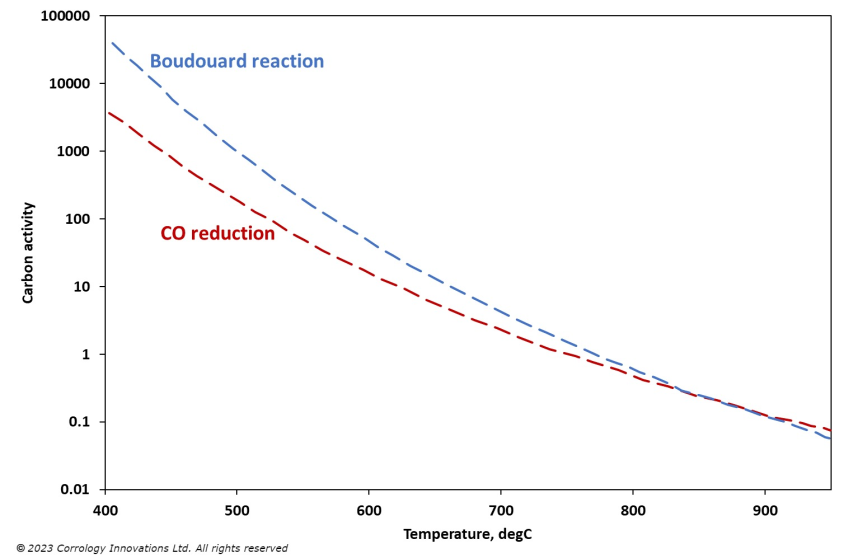
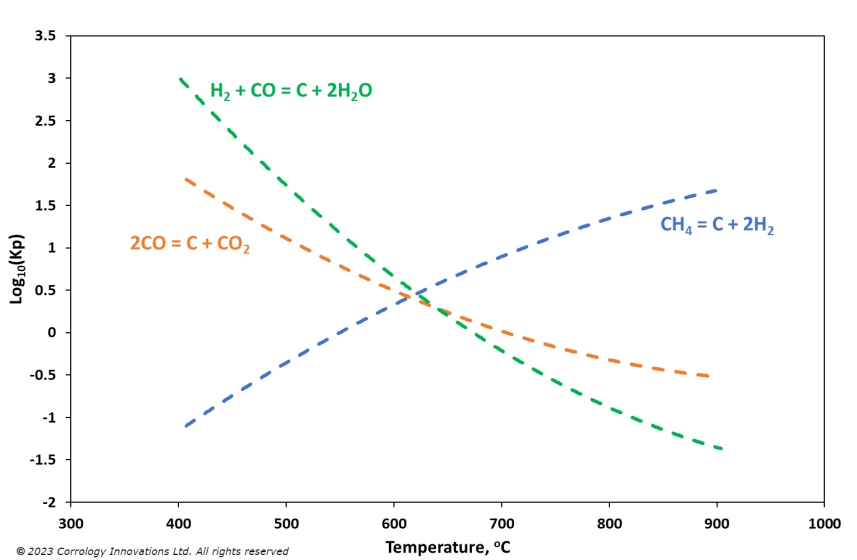
Below are example graphs depicting the equilibrium constants for their respective reactions as functions of temperature and carbon content for carbon steel:1
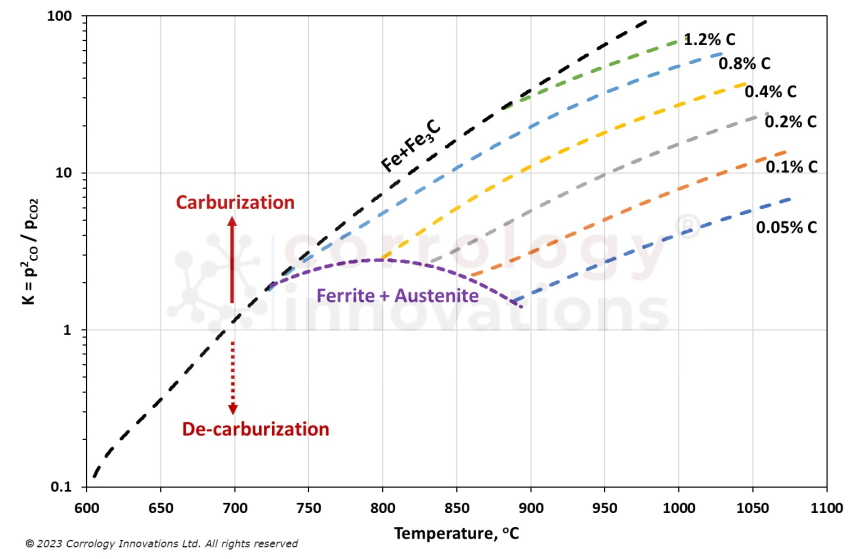
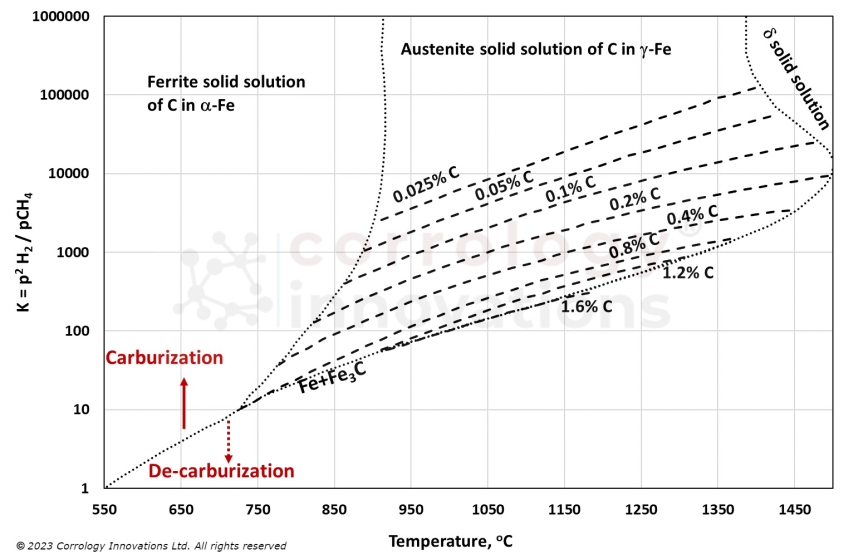
In general, fired heater/furnace tubes and ethylene cracker tubes are the most common types of equipment susceptible to carburization. However, under specific conditions, carburization can occur in other equipment as well. Table 2 illustrates units and process areas impacted by carburization.2
Table 2 Carburization affected process areas.
| Process Unit | Operation area affected by carburization |
|---|---|
| Delayed Coking Unit (DCU) | • DCU heater |
| Fluid Catalytic Cracking Unit (FCCU) | • Regenerator cyclones |
| Catalytic Reforming | • Catalytic reforming heaters |
| Visbreaker Unit (VBU) | • VB Heater tubes (radiant/convection) |
| Ethylene Cracker Unit | • Cracker tubes |
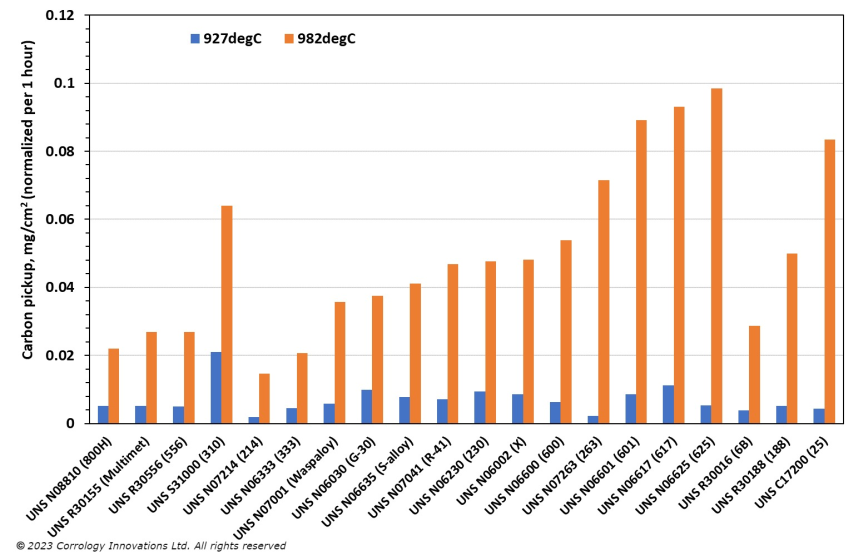
Carbon steel and low alloy steels are considered the most susceptible materials to carburization. The susceptibility to carburization decreases with increasing chromium content. Austenitic stainless steels are more resistant than typical chromium steels due to their higher chromium and nickel content. Below are the performance results of various commercial alloys in carburization tests:7
Mitigating carburization damage involves:
- Controlling operating conditions, such as reducing the carbon activity of the process environment.
- Maintaining the presence of reactive sulfur compounds and/or maintaining an elevated oxygen partial pressure.
- Applying protective coatings, such as stable oxide scales, aluminum diffusion coatings, and γ-TiAl coatings.
- Selecting appropriate materials.1 3 5
The presence of a surface barrier, such as an adsorbed sulfur layer or an oxide scale, between metal and gas typically serves as protection against carburization. In processes like steam cracking, small amounts of sulfur-containing compounds are often introduced into gas streams. However, practical application, particularly in refining, can be challenging as it may lead to catalyst poisoning or product contamination.3
Regular monitoring and inspection play a crucial role in early detection of signs of carburization damage, allowing for timely implementation of appropriate maintenance or replacement measures. Below are selected guidelines for inspection and detection:1 2 3 4 8 9 10
- Destructive methods are the most common and reliable means of examining carburization.
- Caution should be exercised regarding hardness and hardness testing, as they may create a brittle fracture initiation site.
- In situ metallography should be used in conjunction with other non-destructive evaluation (NDE) techniques for evaluating carburization.
- The results of NDE techniques may be impacted by the surface oxide layer.
- Visual testing (VT) and ultrasonic testing (UT) scanning are ineffective in detecting carburization and determining carburized thickness, respectively.
- A non-destructive method, such as the ultrasonic time-of-flight diffraction (TOFD) technique, can provide images and measure the depth of carburization. However, the inspection protocol and set-up parameters are critical in identifying carburization
Other
More information and calculation tools will come soon.
References
This Article has 10 references.
1:C.A.C. Sequeira - High Temperature Corrosion: Fundamentals and Engineering - Wiley series in corrosion (2019).
2:American Petroleum Institute Recommended Practice – API RP 571, latest edition.
3:D.J. Young - High Temperature Oxidation and Corrosion of Metals - Elsevier corrosion series (2008).
4:Franks, A.R., Bagnall, S.L., Brear, J.M., Williamson, J., Conlin, P. Reid, G. - Carburization and Metal Dusting in Fired Heaters and Steam Methane Reformers: Plant Integrity Issues - NACE AWS Conference 2017.
5:D.J. Young, J. Zhang - Carbon corrosion of alloys at high temperature - Journal of the Southern African Institute of Mining and Metallurgy, 2013.
6:G.Y. Lai - High Temperature Corrosion Problems in the Process Industries - Journal of Metals, Vol. 37, No. 7 (1985).
7:G.Y. Lai, M.F. Rothman, D.E. Fluck - High Temperature Corrosion and Selection of Materials for various Industrial Processing Equipment - NACE Corrosion Conference 1985, paper no. 14.
8:J. Lilley, R. Camarena - The Detection and Assessment of Carburisation Damage in Visbreaker Heater Tubes - European Conference NDT (2006).
9:British Standard - Guide to Calibration and setting-up of ultrasonic time of flight diffraction (TOFD) technique for the detection, location and sizing of flaws - BS 7706: 1993.
10:J. Xie, M. Crawford, L. Davies, D. Eisenhawer, R. Saunders, L. Benum - An Approach to Determine the Initiation of Carburization In a 304H Stainless Steel Piping Under Petrochemical Environment - NACE Corrosion Conference 2011, paper no. 11145.