Creep and Stress Rupture
General Information
Under applied or internal stress and at elevated temperatures, the polycrystalline structure of metal tends to dislocate along the grain boundaries, resulting in the formation of grain boundary voids. These voids weaken the metal’s overall structure, leading to a reduction in its strain properties. This deterioration in mechanical properties can occur even when the stress levels are below the material’s elastic yield stress. The elastic yield stress is the point at which a material begins to deform plastically and will not return to its original shape when the applied stress is removed. When grain boundary voids form, the metal can no longer withstand the same level of stress without deforming, compromising its integrity and performance. Temperature plays a critical role in determining the creep rate, and below a specific level – which varies for different materials – it is generally assumed that creep will not progress, or its rate can be neglected. Table 1 shows some creep threshold temperatures for popular materials.1
Table 1 Creep Temperature Threshold for Various Materials 1
| Material | Temperature Limit |
|---|---|
| Carbon steel (UTS ≤ 414MPa or 60 ksi) | 343°C / 650°F |
| Carbon steel (UTS > 414MPa or 60 ksi) | 371°C / 700°F |
| Carbon Steel (Graphitized) | 371°C / 700°F |
| C-1/2Mo | 399°C / 750°F |
| 1-1/4Cr-1/2Mo (N & T) | 427°C / 800°F |
| 1-1/4Cr-1/2Mo (A) | 427°C / 800°F |
| 2-1/4Cr-1Mo (N & T) | 427°C / 800°F |
| 2-1/4Cr-1Mo (A) | 427°C / 800°F |
| 2-1/4Cr-1Mo (Q & T) | 427°C / 800°F |
| 2-1/4Cr-1Mo -V | 441°C / 825°F |
| 3Cr-1Mo -V | 441°C / 825°F |
| 5Cr-1/2Mo | 427°C / 800°F |
| 7Cr-1/2Mo | 427°C / 800°F |
| 9Cr-1Mo | 427°C / 800°F |
| 9Cr-1Mo-V | 454°C / 850°F |
| 12Cr | 482°C / 900°F |
| AISI 304/304H (UNS S30400 / S30409) | 510°C / 950°F |
| AISI 316/316H (UNS S31600 / S31603) | 538°C / 1000°F |
| AISI 321 (UNS S32100) | 538°C / 1000°F |
| AISI 321H (UNS S32109) | 538°C / 1000°F |
| AISI 347 (UNS S34700) | 538°C / 1000°F |
| AISI 347H (UNS S34709) | 538°C / 1000°F |
| Alloy 800 (UNS N08800) | 565°C / 1050°F |
| Alloy 800H (UNS N08810) | 565°C / 1050°F |
| Alloy 800HT (UNS N08811) | 565°C / 1050°F |
| Alloy HK-40 (UNS J94204) | 649°C / 1200°F |
Many industrial processes’ materials are exposed to temperature far above the thresholds listed in Table 1. Therefore, it is also important to know the upper limits where prolonged exposition will result accelerated creep damages. There are several normative documents highlighting specific temperature limits (see Table 2) for certain applications (e.g. boiler tubes). During design process it is important to properly match application type, material and relevant process conditions.
Table 2 Design Metal Temperature Limits.6
| Material | Type | Metal TemperatureLimitingDesign, C (F) | TemperatureLowerCritical, C (F) |
|---|---|---|---|
| Carbon steel (low) | n/a | 540 (1000) | 720 (1328) |
| Carbon steel (medium) | B | 540 (1000) | 720 (1328) |
| C-1/2Mo | T1/P1 | 566 (1150) | 720 (1328) |
| 1-1/4Cr-1/2 Mo | T11/P11 | 650 (1202) | 775 (1427) |
| 2-1/4Cr-1Mo | T22/P22 | 650 (1202) | 805 (1481) |
| 3Cr-1Mo | T21/P21 | 650 (1202) | 815 (1499) |
| 5Cr-1/2Mo | T5/P5 | 650 (1202) | 820 (1508) |
| 5Cr-1/2Mo-Si | T5b/P5b | 650 (1202) | 845 (1553) |
| 9Cr-1Mo | T9/P9 | 705 (1301) | 825 (1517) |
| 9Cr-1 Mo-V | T91/P91 | 705 (1301) | 830 (1526) |
| 9Cr-2Si-1Cu | T921/P921 | 705 (1301) | 785 (1445) |
| 10.5Cr-V (Alloy 115) | T115/P115 | 677 (1250) | 830 (1526) |
| 18Cr-8Ni | 304/304H | 815 (1499) | - |
| 18Cr-8Ni | 304L | 815 (1499) | - |
| 16Cr-12Ni-2Mo | 316/316H | 815 (1499) | - |
| 16Cr-12Ni-2Mo | 316L | 815 (1499) | - |
| 18Cr-12Ni-3Mo | 317L | 815 (1499) | - |
| 18Cr-10Ni-Ti | 321 | 815 (1499) | - |
| 18Cr-10Ni-Ti | 321H | 815 (1499) | - |
| 18Cr-10Ni-Nb | 347 | 815 (1499) | - |
| 18Cr-10Ni-Nb | 347H | 815 (1499) | - |
| 18Cr-10Ni-Nb | 347LN | 694 (1281) | - |
| 18Cr-10Ni-3Cu-Nb | 347AP | 815 (1499) | - |
| Ni-Fe-Cr | 800 | 815 (1499) | - |
| Ni-Fe-Cr | 800H | 900 (1652) | - |
| Ni-Fe-Cr | 800HT | 1010 (1850) | - |
| 25Cr-20Ni | HK-40 | 1010 (1850) | - |
Components such as piping, tubes, and furnace walls that operate above the thresholds presented in Table 1 can experience creep deformation, leading to dimensional changes, distortion, and ultimately, structural failure if not adequately addressed. Stress rupture failures in refineries typically occur in:
Table 3 Typical Areas for Creep in Refining and Petrochemical Industries. 1 2 3 4
| Unit | Creep Affected Area | Comments |
|---|---|---|
| Catalytic Reforming | Hot wall reactor Reactor’s internals, hangers, supports etc. Furnace tubes | Several parallel mechanisms to creep may occur: HTHA, de-carburization, methane blistering, micro-fissuring, Fatigue, Thermal fatigue Creep-fatigue etc. Brittle failure during startup/shutdown, Temper embrittlement/hydrogen embrittlement etc. |
| FCC | Hot-wall reactors Regenerator Flue-gas piping Main fractionator | - |
| Steam reforming | Reformer tubes, internals | - |
| Steam cracking | Cracker tubes and internals | - |
| CDU/VDU | Fired heater’s tubes | Excessive fouling of furnace tubes may cause local overheating and hence acceleration of creep rate. |
| Utilities | Steam boiler’s tubes and internals | On waterwall side in HP boilers creep and hydrogen are leading damages – both mechanisms have external appearance which may be confusing during Root Cause Analysis (RCA) |
Mechanism and Parameters
Creep refers to the gradual, irreversible deformation of material that occurs at stress levels below the yield point when metals or alloys are subjected to elevated temperatures. Three distinct phases of creep can be distinguished: primary, secondary, and tertiary (see Figure 1). Primary creep begins at a relatively rapid pace but diminishes in rate over time, constituting the shortest phase. Subsequently, secondary creep follows, characterized by a constant rate of deformation and representing the lengthiest phase. Note that there is no concurrent loss of strength during the primary and secondary stages. Finally, the tertiary phase commences as the rate of deformation accelerates. This phase progresses rapidly, with the rate continuing to escalate until failure occurs. It is during this phase that the material experiences a loss of strength, leading to permanent deformation and eventual failure.
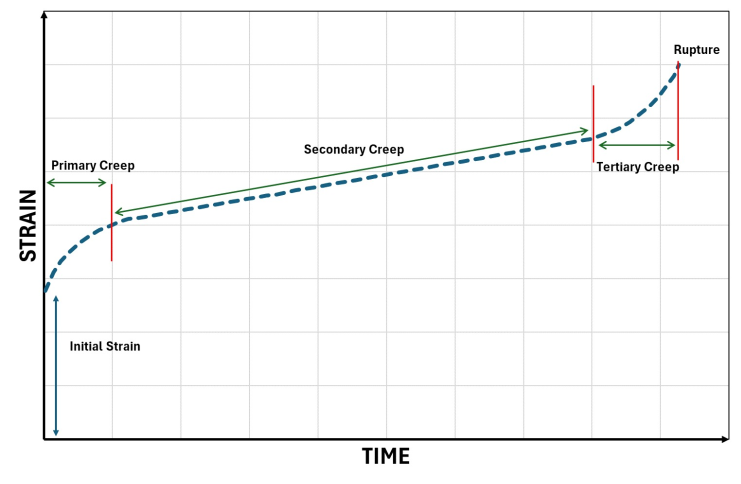
As the creep process in a material results from the combined effects of applied stress, operating temperature, and exposure time, accurately determining a material’s behavior experimentally for long-term fluctuating operating conditions (over 10 years) is not practical. Therefore, for design purposes, the estimation of creep damage is based on a simplified approach that focuses primarily on the secondary creep phase, where the stress-temperature relationship is almost linear (refer to Figure 1). These creep data were developed from various long-term laboratory experiments typically conducted over periods ranging from 50,000 to 250,000 hours at lower stress and temperature, and then extrapolated to typical process conditions. The reference point is usually 1% elongation of the material exposed to a constant load over 100,000 hours (approximately 11.4 years). Stress-temperature curves (see Figure 2) are successfully used for predicting creep behavior in the most popular materials that have been in service for up to 200,000-300,000 hours.
Figure 2 Generic stress-temperature screening curves for 347 stainless steel. 7 8
Creep-resistant materials are commonly used in refinery equipment to withstand high-temperature, high-stress environments and to mitigate the risk of creep-related failures. Proper design and material selection are essential for managing creep and stress rupture in refinery equipment, ensuring safe and reliable operations. Refineries also employ strategies such as regular inspections, maintenance programs, monitoring of operating conditions, and adherence to recommended stress and temperature limits to minimize the risk of equipment failures and maintain operational integrity.
Other
Information about inspection techniques, and guidelines for creep and stress analysis will be available soon to provide enhanced resources for optimizing material selection and improving operational safety.
References
This Article has 7 references.
1:American Petroleum Institute Recommended Practice – API RP 571, latest edition.
2:A.G. Howell - Comparison and Contrast: Hydrogen Damage VS. Creep Failure In Waterwall Tubes - NACE Corrosion Conference 1997, paper no 462.
3:E.P. Thurston - Boiler Inspection Techniques: Tools and Degradation Identification - NACE Corrosion Conference 2006, paper no. 06465.
4:G.P. Kallenberg, T. Munsterman - Remaining Life Assessment Of Catalytic Reforming Reactors - NACE Corrosion Corrosion 2002, paper no. 02481.
5:L. Shi, D.O Northwood - Recent Progress in the Modeling of High-Temperature Creep and Its Application to Alloy Development - Journal of Materials Engineering and Performance, 1995 196. Vol. 4(2). p 196-211.
6:American Petroleum Institute Recommended Practice – API RP 530, latest edition
7:American Petroleum Institute Recommended Practice – API RP 579, latest edition