High Temperature H2-H2S Corrosion
General Information
High-temperature H2-H2S corrosion represents a more aggressive form of traditional sulfidation. In this process, various sulfur species directly interact with the metal surface, forming corresponding sulfide scales. While H2-H2S corrosion also results in the formation of metal sulfide scales, the presence of hydrogen distorts this process, ultimately leading to higher corrosion rates compared to sulfidation without H2. For details on sulfidation, please refer to the Sulfidation Chapter.
It is worth noting that H2-H2S corrosion has not been the subject of as extensive research as sulfidation without H2. The primary investigations into H2-H2S corrosion were conducted over 50 years ago, leading to the formulation of what is known as the Couper-Gorman curves.1 2 3 These curves, following subsequent adjustments, establish correlations among H2S concentration, temperature, and the corrosion rate of diverse materials. While the Couper-Gorman curves reasonably predict corrosion rates in specific scenarios, in others, particularly at very low H2 concentrations, the predicted rates are lower than those observed in practical settings.6 7
Table 1 lists typical process areas susceptible to H2-H2S corrosion.
Table 1 Potential locations for H2-H2S corrosion in Hydroprocessing Units.3 5
| Affected Area | Comments |
|---|---|
| Feed stream after H2 injection | Operating T: >230°C (>446°F) Before injection: use McConomy curves After injection: use Couper-Gorman curves |
| Reactor outlet to hot HP separator | Operating T: >230°C (>446°F) Couper-Gorman curves are in good correlation with industry data |
| From hot HP separator to REAC (before water wash) | Operating T: >230°C (>446°F) Couper-Gorman curves are in good correlation with industry data |
| Separator to Stabilizer column | Operating T: >230°C (>446°F) Select either the McConomy or the Couper-Gorman curves based on the presence or absence of H2 McConomy/Couper-Gorman curves are in good correlation with industry data |
| Stabilizer/Reboiler | Operating T: >230°C (>446°F) Couper-Gorman curves are in good correlation with industry data McConomy curves are in good correlation with field data at low H2S and lack of H2 |
Mechanism
The mechanism behind corrosion under H2-H2S conditions remains elusive. It’s commonly assumed that H2S interacts with metals similarly to the sulfidation process, yet the influence of hydrogen remains incompletely understood. There’s a prevalent belief that hydrogen may expedite the decomposition of sulfur species, leading to excessive H2S formation and accelerated corrosion. This notion is often invoked to explain why chromium-containing alloys exhibit heightened susceptibility to sulfidation in the presence of H2S compared to when exposed to an H2-free environment. In fact, low chromium alloys (5%Cr and 9%Cr) generally offer no greater resistance to H2-H2S corrosion than carbon steel. Despite numerous laboratory and field observations, the exact role of hydrogen in this process remains inconclusive.5
Key Variables
The rate of high-temperature H2-H2S attack is influenced by several critical factors, with temperature, H2S/H2 concentration, and material composition (specifically, alloying element content) standing out as the most significant.1 The relationship between H2S concentration, temperature, and corrosion rates for various materials and different stream components (such as naphtha and gas oil) is illustrated by Couper-Gorman curves. The following chapters will delve into key factors that influence H2-H2S corrosion in detail.
Temperature and Concentration
The Couper-Gorman curves illustrate how process temperature and H2S concentration affect corrosion rate of various materials, as shown in Figure 1.
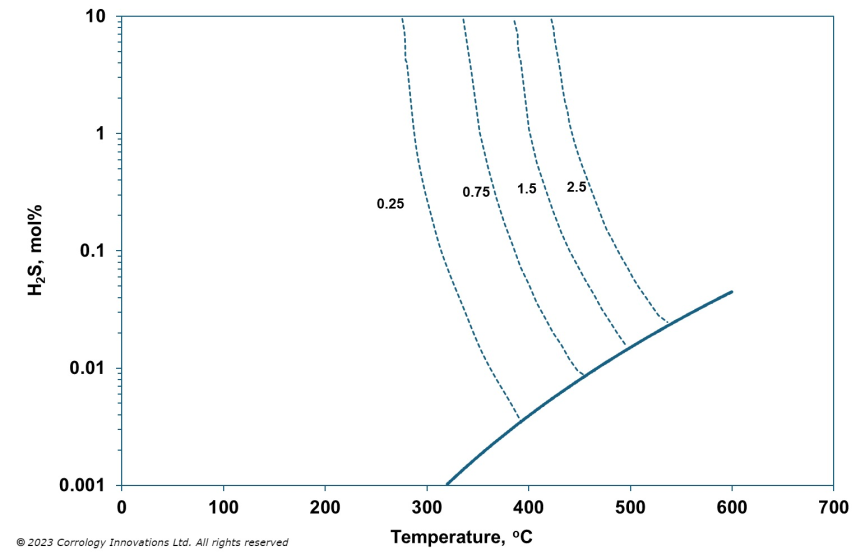
Developed over 60 years ago and refined through industry feedback and experience, these iso-corrosion curves are, however, subject to debate regarding their accuracy in predicting HT H2-H2S corrosion. While some researchers suggest a reasonably strong correlation with real-world field corrosion, other studies yield somewhat conflicting findings.5 6 7 Despite ongoing debates, these curves continue to serve as vital tools for assessing corrosivity levels in high-temperature H2-H2S environments. For HT H2-H2S corrosion calculator based on the Couper-Gorman curves, refer to the Calculation Tool section.
Flow
The Couper-Gorman curves do not account for the influence of flow. Nonetheless, it is widely recognized that certain areas, such as hydrogen injection points, may be more prone to corrosion due to high turbulence. A similar scenario arises near control valves or orifice plates.3 5
Materials
In general, the presence of hydrogen significantly impacts the sulfidation process. Various theories attempt to explain this phenomenon; however, none are undisputedly acknowledged. Increasing the alloying content, particularly chromium (Cr), enhances resistance to HT H2-H2S corrosion. However, a reasonable level of protection can be achieved with chromium concentrations of 12% and above. It is worth noting that carbon steel exhibits similar corrosion resistance (or lack thereof) as 9Cr-1Mo alloyed steel. At the same time, 9Cr-1Mo provides satisfactory performance in H2-free sulfidation processes. Austenitic stainless steels from the 300 series demonstrate satisfactory performance under H2-H2S conditions.
Material selection for HT H2-H2S corrosion commonly relies on Couper-Gorman curves, which additionally incorporate the effect of hydrocarbon type (gas oil or naphtha). In most applications, these curves provide a very conservative approach, assuming worst-case scenarios with corrosion rates typically observed by industry practices. On the other hand, it may underestimate corrosion rates for very low concentrations of H2 and H2S, as suggested by some industry surveys.5
Tools
Below is a user-friendly calculator to estimate corrosion rates in High Temperature H2-H2S service using the Couper-Gorman approach.
Calculator
NOTICE: The provided tool is for advisory purposes only. Corrology Innovations Limited and its employees shall not be held liable for any damages, resulting from the use or inability to use the information provided.
References
This Article has 7 references.
1:American Petroleum Institute Recommended Practice – API RP 571, latest edition
2:American Petroleum Institute Recommended Practice – API RP 581, latest edition
3:American Petroleum Institute Recommended Practice – API RP 939-C, latest edition
4:Rebak R.B. - Sulfidic corrosion in refineries – a review - Corrosion Rev, 29 (2011): 123–133
5:NACE International - Overview of sulfidation (sulfidic) corrosion in petroleum refining hydroprocessing units - Publication 34103, Task Group 176, Houston, TX: NACE International, 2014
6:D. Farrell, L. Roberts - A Study Of High Temperature Sulfidation Under Actual Process Conditions - NACE Corrosion Conference 2010, paper no 10358
7:O.S. Abdulgader - Abnormal Hydrotreater Distillation Sulfidation Corrosion at Stripper Reboiler Outlet Investigation Study - AMPP Corrosion Conference 2021, paper no. 16763