High Temperature Hydrogen Attack
General Information
At high temperatures and elevated partial pressures, hydrogen can attack carbon and low-alloy steels by reacting with carbon and/or carbides to form methane. These reactions may occur either on the metal surface or within the metal lattice, leading to decarburization (surface reactions) and the formation of microcracks or blisters (internal reactions). Internal defects like cracks, blisters, or voids can significantly weaken the steel’s mechanical properties, potentially resulting in catastrophic failure. 1 ,2
Mechanism
The HTHA process is driven by reactions between hydrogen and carbon (predominantly in the form of cementite, Fe₃C) present in carbon steel and low alloy steels, which can be simplistically described by Reaction 1:
\(\ce{Fe3C + 2H2 -> 3Fe + CH4} \quad \text{(Reaction 1)}\)
Of course, the entire HTHA process is far more complex, involving adsorption/desorption processes, diffusion, and a series of radical reactions, which collectively lead to the eventual formation of methane molecules. Specific details of the HTHA mechanism are, however, beyond the scope of this chapter and can be found elsewhere.
It is also worth mentioning that, although the typical HTHA mechanism is driven by hydrogen in the gas phase, there have been documented cases of attack occurring in the liquid hydrocarbon phase. Therefore, it is recommended to assume the same hydrogen concentration in the liquid phase as in the gas phase when defining boundaries for material selection.2
Key Variables
Despite of relatively simple chemical background, the actual rate of HTHA is impacted by several parameters including, but not limited to, carbon content, hydrogen partial pressure, temperature, primary and secondary stress or presence of alloying element(s).
Hydrogen partial pressure and temperature
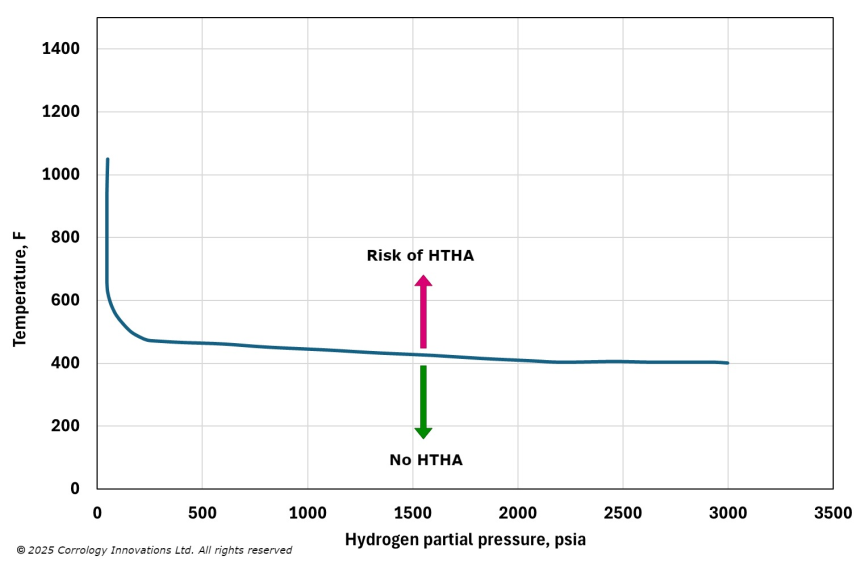
These two correlated parameters, presented in the form of the well-known Nelson curves (see Figure 1), are commonly used to assess a material’s susceptibility to HTHA.2
It is also generally assumed that, as long as equipment operates below a given curve’s hydrogen partial pressure (H₂pp) and temperature (T), there is no theoretical basis for limiting its service life or expecting HTHA to occur.2
There is also a consensus that the Nelson curves are already conservative by approximately 30–50°F. However, many users - as well as the API 581 standard - further lower the Nelson curve limits by an additional 50-100°F to maintain the necessary safety margin.2 ,3
Carbon content
Carbon and carbide content are key factors influencing the onset of HTHA, as they serve as sources of carbon for the methane formation reaction. The higher the amount of free carbon and unstable carbides, such as Fe₃C, the more methane can be generated. Conversely, stable carbides (containing Cr, Mo, V, Ti) contribute to increased resistance to HTHA.2
The presence of alloying elements reduces the amount of active carbon, thereby decreasing methane formation from both kinetic and thermodynamic perspectives. Determining carbon activity is a complex task; therefore, it is commonly assumed that carbon activity is equivalent to the carbon content in the steel. This approximation works reasonably well for typical low-alloy steels containing 1–3% chromium.2
Because the presence of carbides is important for the progression of HTHA, post-weld heat treatment (PWHT), which reduces the amount of alloy carbides formed during the welding process, has been found beneficial—based on both industry and laboratory experience—for improving resistance to HTHA. Furthermore, the reduction of residual stress during PWHT is typically beneficial for the steel’s serviceability.1
Applied stress (primary and secondary)
Primary stress—defined as stress resulting from imposed pressure, mechanical loading, and other external forces—should be considered when assessing susceptibility to HTHA. However, it has been observed that as long as equipment (such as pressure vessels or piping) operates within the limits of applicable design codes (typically ASME B31.3 or ASME BPVC Section VIII), primary stress is not expected to play a significant role.
Elevated secondary stresses—such as those resulting from thermal gradients or cold work—have been found to play a vital role in accelerating HTHA in 2.25Cr-1Mo steel. Although there is no extensive evidence of secondary stress effects in other materials, it can be reasonably assumed that their behaviour will be similar.1 ,2
Impact of other variables
Temperature, hydrogen partial pressure, or active carbon content does not constitute an exhaustive list of parameters that may influence a steel’s susceptibility to HTHA. Table 1 presents additional parameters, along with their potential roles in HTHA.
Table 1 Impact of various parameters on HTHA.
| Parameter | Comments |
|---|---|
| Metal Thickness | • Thick metal can reduce the hydrogen concentration gradient, allowing higher levels of dissolved hydrogen to penetrate more deeply into bare and/or clad steels. |
| Cladding | • Austenitic and ferritic (9–12% Cr) cladding significantly reduce hydrogen partial pressure (H₂pp) at the clad–backing metal interface, thereby slowing the progression of high-temperature hydrogen attack (HTHA) • Austenitic stainless steels are generally more effective than ferritic steels in reducing H₂pp • The effectiveness of cladding typically decreases with increasing thickness of the backing steel. |
| Grain Size | • Adverse effects have been observed in coarse-grain heat-affected zones following welding. |
| Corrosion products | • The role of corrosion products is dualistic—they may either accelerate or retard hydrogen dissolution. However, their primary function is generally considered to be the formation of a barrier that impedes hydrogen entry. |
| Inclusions/Discontinuities | • Areas with weak or low-energy interfaces (e.g., caused by inclusions) can promote methane formation, thereby initiating the nucleation of voids or blistering. |
Inspection
Early detection of High-Temperature Hydrogen Attack (HTHA) is a challenging process. The development of internal decarburization, voids, and cracks is preceded by a so-called “incubation period,” during which no easily detectable damage is present. Detection becomes significantly easier in the advanced stages of the attack due to pronounced cracking; however, at this point, the likelihood of equipment failure is already elevated. Tables 2 and 3 provide a general overview of commonly used ultrasonic and non-ultrasonic techniques for detecting HTHA at different stages of progression.
Table 2 Ultrasonic techniques for HTHA detection. after 1 ,4 ,5 .
| Time of Flight Diffraction (TOFD) | Phased Array Ultrasonic Testing (PAUT) | Full Matrix Capture/Total Focusing Method (FMC/TFM) | |
|---|---|---|---|
| Detection | ++ | +++ | +++ |
| Inspection Effectiveness | Usually Effective | Usually Effective | Usually Effective |
| Comments | Detects HTHA in base metal, HAZ, and weldments. Effective for length, depth (location), and height sizing. Not effective for precise location and sizing in the direction perpendicular to the scan (width). Support from PAUT or FMC/TFM may be required | Capable of detecting HTHA in base metal, weld HAZ, and weldments. Usually effective in sizing length, depth, height, and width. Depends on inspection setup quality. | Can detect HTHA in base metal, weld HAZ, and weldments. Usually effective for sizing length, depth (location), height, and width. With an appropriate inspection setup, it can outperform PAUT in effectiveness. |
Note: For higher effectiveness, a combination of two or three methods may be considered.
Table 3 Non-UT techniques for HTHA detection.after 1
| Wet Fluorescent Magnetic Particle Test (WFMT) | High sensitivity WFMT | Radiography (RT) | Visual (VT) | Acoustic Emission (AE) | |
|---|---|---|---|---|---|
| Detection | ++ | ++ | + | (-) | + |
| Comments | only when cracks are formed, no detection of fissures/voids | detecting early/late-stage, HTHA damage | detecting late-stage HTHA damages, not suitable for early stage. | Locate surface blisters which are usually indication of late stage of HTHA. | detecting discontinuities with high-stress concentration, likely at late-stage HTHA damage. |
| Recommendations | Internal inspection of pressure vessels, detecting surface-breaking cracks | Internal inspection of pressure vessels. Detection surface cracks and HTHA damages | Not recommended as a primary inspection method for HTHA damages | Not recommended | Recommended only as a supportive technique. Not recommended as primary technique |
Tools
Below is a user-friendly tool to estimate likelihood for HTHA based on the Nelson curves.
References
This Article has 5 references.
1:American Petroleum Institute Recommended Practice – API RP 941, latest edition
2:American Petroleum Institute Technical Report – API TR 941, latest edition
3:American Petroleum Institute Recommended Practice – API RP 581, latest edition
4:C. Wassink, F. Reverdy, G. Neau, O. Roy - New UT techniques for HTHA detection – lessons from the field - AMPP Corrosion Conference 2019, paper no. 16320
5:M. Nugent, T. Silfies, J. D. Dobis, T. Armitt - A Review of High Temperature Hydrogen Attack (HTHA) Modeling, Prediction, and Non-Intrusive Inspection in Refinery Applications - NACE Corrosion Conference 2017, paper no. 8924