Naphthenic Acid Corrosion
General Information
Historically, the term ’naphthenic acids’ referred to organic acids featuring saturated aliphatic rings with a carbon atom count ranging from 6 to 20, primarily found in crude oil and distillation side cuts. However, its definition has evolved to encompass all types of organic acids, including those with both saturated and unsaturated rings, some with structures containing up to 50 carbon atoms (see Figure 1). The molecular weight (MW) of these acids varies approximately from 100 to nearly 600-700 atomic units (au).
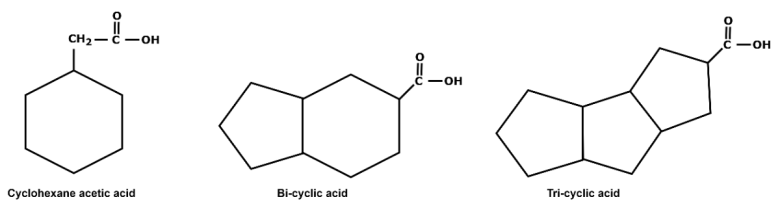
Crude oil comprises various types of naphthenic acids (with different molecular weights and boiling points), which undergo separation during distillation. Consequently, different types of naphthenic acids (NA) are distributed into specific side cuts at varying concentrations. Assessing the concentration of NAP acids in specific side cuts can pose a challenge.
The Total Acid Number (TAN), determined according to ASTM D664 and expressed in mg KOH/g, is traditionally utilized for assessing the acidity of crude oil or side cuts (refer to Figure 2). However, it’s essential to note that TAN reflects the combined interaction of all acidic species present in the crude oil or side cut, such as dissolved H2S or phenolic acids. Therefore, caution should be exercised when using TAN for determining NAP acid corrosion.
To specifically determine the acidity originating from naphthenic acids, it is necessary to extract these acids and perform titration according to the standard ASTM D664. The resulting acid number, known as the Naphthenic Acids Titration Number (NAT), accurately reflects the acidity from naphthenic acids. However, this method is neither simple nor inexpensive, primarily utilized in scientific exercises.
Alternative methods, such as infrared spectroscopy (e.g., FTIR – Fourier Transform Infrared) or Fast-Atom Bombardment – Mass Spectroscopy (FAB-MS), have been suggested as potentially useful tools for assessing NAP acid concentration.1 2
A high concentration of naphthenic acids, expressed as TAN, does not necessarily imply high corrosivity of the crude oil or side cut. The decisive factor lies in the concentration of light, low-molecular-weight naphthenic acids and their distribution among crude fractions. It is a confirmed phenomenon that naphthenic acids with low molecular weight, boiling points below 350-400°C (662-752°F), exhibit the highest aggressiveness towards carbon steel and low-alloy steels (see Figure 3).3 However, this generic rule does not apply universally to all NAP acids. It has been observed that acids with specific structures, such as those with multiple saturated and unsaturated rings, may not exhibit the expected level of aggressiveness towards metallic materials.2 3 4 In general, the most aggressive naphthenic acids are those with a molecular weight of less than 200 atomic units (au), possessing a short aliphatic chain and a single saturated ring composed of 5 or 6 carbon atoms. Conversely, heavier compounds with a molecular weight greater than 200-300 au, containing two or more cyclic structures, typically display lower corrosivity.


Naphthenic acid corrosion primarily occurs in crude distillation units, including both atmospheric and vacuum sections. Apart from the CDU/VDU, NAP acid corrosion may also be observed in the delayed coking unit (DCU), particularly on the coking gas oil loops and at the bottom of the fractionator.5 However, in other units such as FCC or Hydrotreating/Hydrocracking, the occurrence of NAP acid corrosion is relatively elusive (refer to Table 1).
Table 1 Naphthenic acid corrosion affected process areas.
| Process Unit | Operation area affected by naphthenic acid corrosion |
|---|---|
| Crude Distillation Unit (CDU) | • Hot section of crude pre-heat lines (above 230°C / 446°F) • Furnace (radiant and convection sections) • Transfer lines • Bottom section of atmospheric column • Side strippers operating above 230°C / 446°F • Atmospheric residue lines |
| Vacuum Distillation Unit (VDU) | • Vacuum Furnace (radiant and convection sections) • Transfer lines • Whole vacuum column excluding top sections operating below 230°C (446°F) • Side cut piping/lines (in particular: Vacuum Gas Oils (VGOs) – Light, Medium, and Heavy) • Vacuum residue lines |
| Delayed Coking Unit (DCU) | • Bottom section of fractionation column • LCGO pumparound (Light Coking Gas Oil) • HCGO pumparound (Heavy Coking Gas Oil) • HCGO stripper • Feed lines to fractionator |
| Fluid Catalytic Cracking (FCC) | • FCC Feed Heater • Transfer lines from Heater to FCC Reactor |
| Hydroprocessing Hydrotreating/Hydrocracking (HP/HT/HC) | • Charge Heater (radiant and convection sections) |
| Visbreaker Unit (VBU) | • VB Heater tubes (radiant/convection) |
Mechanism
From a chemical perspective, corrosion induced by naphthenic acids is simply a metal-acid reaction, as depicted in Equation 1, leading to the formation of corresponding salts (naphthenates) and the release of gaseous hydrogen. The iron-naphthenate compounds formed are oil-soluble and are removed from the metal surface, exposing the bare metal to further acid action. Consequently, NAP acid corrosion typically manifests as localized metal loss, especially in sections of pipes or equipment experiencing high turbulence.6
Additionally, naphthenates can decompose, forming an iron oxide layer that lacks significant corrosion-protective properties.7 8 9 Furthermore, the presence of FeS scale adds another layer of complexity to NAP acid corrosion by potentially involving FeS in reversible reactions with NAP acids, as illustrated in Equation 2.

In this way, naphthenic acids can degrade the protective FeS layer formed on the steel surface after reacting with sulfur species. At low concentrations of NAP acids, typically recognized when TAN is below 0.3-0.5 mg KOH/g, sulfidation becomes the dominant damage mechanism, and the formed FeS slows down both sulfidic and NAP acid corrosion.5 6 10 11 In contrast, in scenarios where the concentration of naphthenic acids increases beyond approximately 0.5 mg KOH/g, the rate of FeS decomposition surpasses its formation, leading to localized NAP acid corrosion phenomena.
Indeed, the description provided is oversimplified, as these reactions are influenced by several other factors, such as the thickness and structure of the FeS layer, the structure of naphthenic acid, and local fluid dynamics (turbulences), among others. Further chapters will delve into the various aspects of parametric impact on NAP acid reactions.
Key Variables
The corrosion rate of naphthenic acid is determined by a combination of several factors, with the most important listed below:
- temperature,
- type and concentration of naphthenic acids,
- presence of sulfur species,
- type of material,
- fluid dynamics.
Temperature
Based on industry observations and laboratory experiments, a generic rule places the starting temperature for NAP acid corrosion in the same range as sulfidation i.e., 230-240°C / 446-464°F. 12 13 14 Some authors suggest the possibility of a phenomenon called low-temperature naphthenic acid attack, which would begin around or slightly below 200°C / 392°F.5 14 This low-temperature attack was not however widely reported in the literature. Diminishing of NAP acid attack is usually observed at temperature above 370-400°C / 698-752°F when acids are expected to decompose (predominantly via decarboxylation reaction) into low or non-corrosive products.15 Some authors suggest that at high temperatures, the overall tendency for coke formation will also protect steel against NAP acid attack.11
Within the mentioned temperature range of 230-400°C / 446-752°F, the peak of NAP acid attack is typically observed between 300-360°C in VGO and HVGO side cuts.
The generic relationship between temperature and NAP acid corrosion for conditions involving carbon steel and NAP acids appears to follow the trend shown in Figure 4.16 17 Changing the TAN will shift the trend up or down. However, it’s important to remember that such a scenario is oversimplified and idealistic, as it does not account for other factors such as sulfur content and the formation of FeS deposits. API RP 581 provides tables with TAN-S-Temp-Corrosion relations (see Figure 5).18 For low TAN (and low sulfur), the NAP acid corrosion trends resemble the linear correlation depicted in Figure 4. However, for higher TAN levels (>1 mg KOH/g) and temperatures exceeding 300°C / 572°F, the corrosion rate appears to align with the side-cut TAN distribution profiles observed in certain crude assays. Despite this correlation, it’s important to note that it doesn’t offer a complete picture of corrosivity and can sometimes provide misleading information regarding the degradation rate of specific materials (such as 5Cr and 9Cr alloys). Therefore, it should be used cautiously for corrosion-risk assessments, particularly when other information about process stream corrosivity is available..

Figure 5 Example of relation between carbon steel Corrosion rate-T-TAN, for S=0.2 wt%. 18
Type and concentration of naphthenic acids
The role of concentration and types of naphthenic acids should be analyzed in close relation to temperature, as all these elements are interconnected. When considering the structure of NAP acid and its impact on corrosion rate, as stated earlier, we can generally assume that:
MWNAP < c.a. 300au – expect higher corrosivity (sometimes referred as α-acids)19
MWNAP > c.a. 300au – expect lower corrosivity (sometimes referred as β-acids)
However, this statement is quite generic and must be approached with caution. The impact of the NAP acid structure is far more complex and, in fact, not yet fully understood. Firstly, the naphthenic acid “soup” present in crude oil and side cuts may consist of various structures, while laboratory evaluations have primarily focused on individual acidic species.3 4 Secondly, the molecular weight itself is not necessarily a decisive factor that impacts reaction paths or rates. For example, it has been observed that low molecular weight acids like 1,2,3,4-Tetrahydro-2-naphthoic acid (THYNA) with a molecular weight of about 148au exhibit relatively low corrosivity compared to acids with comparable molecular weights (150-160au).3 Other papers have reported that 1-Methylcyclohexanecarboxylic acid (MCHC) with a molecular weight of about 142au exhibits nearly an order of magnitude lower corrosivity (as relative corrosion rate) compared to Cyclohexane carboxylic acid (CHC) with a molecular weight of about 128au. The difference in molecular weight stems from the methyl group attached to MCHC.4 From a fundamental chemistry perspective, this behavior is somewhat anticipated. For instance, the presence of a methyl group could potentially hinder the carboxylic group from adopting a suitable position for initiating reactions with other chemicals.
Hence, exploring alternative parameters that could better explain certain behaviors of naphthenic acids in corrosion reactions is feasible. One potential parameter is the Molecular Complexity (MC) factor. While the Molecular Complexity has not been properly defined and empirically established, it has found successful application in areas such as drug synthesis.20 21 Therefore, the MC approach could prove useful for assessing the propensity of NAP acids towards the ‘synthesis’ of iron naphthenates. An interesting comparison of existing corrosion data with the Complexity Factor (CF) provided by the PubChem database suggests that this could be a promising approach (see Figure 6).3 22

However, this is primarily a thought experiment due to the limited availability of data on individual NAP acid corrosion. Nonetheless, it may serve as a starting point for exploring new perspectives in NAP acid-structure-corrosivity studies.
Presence of sulfur species
The formation of FeS during high-temperature crude operations and its protective nature against sulfidic corrosion have been described in several papers (see Sulfidation). The situation becomes more complex when naphthenic acids coexist with sulfur species, which is typical in crude oil or side cuts, due to potential reactions of NAP acid with metal and/or with FeS (see Mechanism Section). The interaction between sulfur (S) and Total Acid Number (TAN) has been extensively studied over the last 20 years; however, it has led only to generic conclusions, as follows:
No direct correlation between S-TAN and corrosion rate was found,10
Naphthenic acids dissolve FeS layer - leading to increase of corrosion rate,6
S-TAN ratio may have some impact on crude corrosivity, but no direct correlation was developed,23
At low S (0.5 wt.%) and high TAN (3.5 mg KOH/g) naphthenic acid attack is likely a dominant form of corrosion,24
If H2S is formed in the system in sufficient quantities it will react with iron to form FeS which will provide protection against naphthenic acid attack,19
High TAN (>2 mg KOH/g) and high sulfur (>2 wt.%) do not always mean high corrosion rate as specific combination of naphthenic acid types (e.g., β-acids) and high sulfur (with active sulfur allowing for buildup protective FeS) will lower the corrosion rate.25 28
Flow
It was previously mentioned in this chapter that fluid dynamics (such as turbulences, single-phase, or multi-phase flow) may significantly influence the determination of the final NAP acid corrosion rate (as well as sulfidic corrosion). The popular referencing document, API RP 571, does not provide any guidance on velocity limits in the NAP acid corrosion regime. However, some feedback can be found in API RP 939C, which refers to sulfidic corrosion and the presence/removal of protective sulfide films. It is noted that at flow velocities above approximately 60 m/s, the sulfide layer will not form, leading to an intensification of sulfidic corrosion.
This observation is somewhat reflected in API RP 581 Part 2 Annex 2B, where the crude corrosivity calculation route includes a correction factor of x5 for velocities above 30 m/s (approximately 100 f/s). It’s important to note that the velocity limit specified is 50% of that mentioned in API RP 939C, which likely places the overall corrosion calculation on a conservative level.
Laboratory tests published in literature generally indicate that carbon steel exhibits very poor corrosion resistance to both NAP acid and sulfidic corrosion under high flow velocities (>30 m/s / 100 ft/s).31 32 41 42 43 44
Alloyed steels like 5Cr and 9Cr, in general, are more resistant than carbon steel, but they may also exhibit a kind of “swinging” resistance, which essentially depends on the specific S/TAN configuration. This means that even under very high velocities (>60 m/s), they may show reasonably good resistance to crude corrosivity.1 6 16 It has also been observed by some authors that under high velocities (around 200 ft/s / approximately 60 m/s) and specific S/TAN configurations, 5Cr and 9Cr may not exhibit differences in corrosion rates.11
Austenitic stainless steels such as type 316L exhibit good to very good resistance under high flow velocities (>30-40 m/s) with a TAN range of about 1-2 mg KOH/g and total sulfur <2-3 wt%.35 45 Type 317L stainless steel, with its higher Mo and Cr content, exhibits very good to excellent corrosion resistance to NAP acid attack. It is typically the first choice material for equipment and pipelines operating under the most severe TAN/S-flow regimes, such as transfer lines, furnace tubes, and the bottom of the vacuum column.26 11
Materials
Proper material selection, along with blending strategy, is one of the key elements for mitigating NAP acid corrosion. In most cases, NAP acid corrosion is assisted by sulfidation (these two mechanisms are sometimes jointly described as crude corrosivity). Material selection should consider the impact level or ratio of both damage mechanisms.
Many engineers, when selecting materials for high-temperature applications in CDU/VDU, initially consult API RP 581 Part 2 Annex 2B tables for base corrosion rates.18 For assessing crude corrosivity (NAP acid corrosion + sulfidation in the absence of hydrogen), API RP 581 tables are based on modified McConomy curves that incorporate a NAP acid factor via TAN values. However, it’s important to note that these tables should not be used for material selection purposes; they are primarily intended for RBI risk assessment when no other sources for ‘base corrosion’ are available in risk equations.34 While these tables are not entirely inaccurate, a high level of caution is warranted when using them for material selection. Observations indicate that base sulfidic corrosion obtained from modified McConomy curves is generally overestimated in several situations (especially in cases of high sulfur and low TAN).10 25 Some examples of comparisons between modified McConomy (with NAP acid effect) and literature data for carbon steel and 5Cr alloys are illustrated in Figures 7 and 8.
Hence, it’s crucial to consider the current state of knowledge regarding corrosivity levels under specific process conditions when selecting materials for situations involving NAP acid attack and sulfidic corrosion.
Basic rules-of-thumb for material selection under increasing concentrations of both naphthenic acids and sulfur in processed crudes have evolved over the last two decades based on field experience and laboratory exercises. Table 2 presents some results on material behavior under various TAN/S conditions (both under field and laboratory conditions).
Figure 7 Comparison of modified McConomy (with nap acid impact) and literature results (carbon steel, T= 300-320°C, S = 0.2, 0.4 & 0.6 wt.%)18 29 30 31 32
Figure 8 Comparison Literature and Modified McConomy/TAN (API581) 5Cr steels corrosion rates at different S & TAN, temperature c.a. 300-320°C.29 30 31 32 33
Table 2 Examples of behavior of various steels under naphthenic acid attack and sulfidic corrosion
| S/TAN scenario | Material of Construction (MoC) | Comments | Reference |
|---|---|---|---|
| TAN ≫ 1.5 | 316L, 316Ti, 317L | A review of some field failures indicates that the majority of observed failures with those alloys occurred at TAN levels exceeding 3, particularly in condensing systems and/or high-velocity environments (e.g., transfer lines). | 34 |
| S<2-3wt%, TAN<0.5 mg KOH/g | Carbon steel + 5Cr-0.5Mo + 9Cr-1Mo; 12Cr – column internals; 316L in transfer line | Recorded on Venezuelan crude with thiophenic sulfur (stable, does not easily decompose with H2S release). | 35 |
| S <3.5wt%, TAN >4 mg KOH/g | Heater tubes (CDU/VDU) – 317L 316L/CS cladded with 317L preheat exchangers (hot section – HVGO) HVGO PA - 317L, Valves in HVGO loop – 317L | Upgraded from 9Cr-1Mo | 36 |
| S ≫ 2wt%, TAN ≫ 2 mg KOH/g | Upstream to H2 injection: CS for streams <250°C 317L for streams >250°C Upstream to H2 injection: 321, 347 | Hydroprocessing units | 37 |
| S ≈ 1wt%, TAN ≈ 2 mg KOH/g | Field coupon tests at 350-370°C. 317L <316L < 444 (ferritic 18Cr, 1.5-2Mo) | Field tests showed lower CR than lab tests (28D vs 4D exposition time respectively) | 38 |
| S ≈ 2wt%, TAN ≈ 1 mg KOH/g | 316L tested in range 250-350°C, long duration (>4D) | CR was <0.0625mm/y | 39 |
| TAN ≈ 2.5 S=N/A | Steels with various Mo content (ferritic) + 316L at 350°C | No significant Mo impact between Mo=5% and 13%. Austenitic steel 316L showed the best performance. | 40 |
| S >2 wt%, TAN >2.5 mg KOH/g | 316L and 317L showed the best performance | Athabasca crude | 25 |
| S >0.5<1wt%, TAN≈1 mg KOH/g | 410 and 5Cr found corroded | Suggestions to upgrade for Mo-containing steel – 316L | 17 |
Based on available data, creating a comprehensive set of rules for materials suitable for crude corrosivity is challenging. The simplistic approach assuming only Total Sulfur and Total Acid Number as the two governing factors for material selection is flawed, leading to either conservative or overly optimistic scenarios. However, some generic hints can be provided:
- For each material selection, consider the potential distribution of NAP acids, even through a simplistic side-cut distribution based on crude assay.
- If possible, determine the amount of low molecular (α) acids, especially in vacuum side cuts.
- Determine mercaptan sulfur and, if possible, thiophenic sulfur.
- Consider sulfur distribution, even if simplistic from crude assay. This may not accurately reflect actual sulfidation propensity if, for example, thiophenes are the dominant sulfur species.
- For low sulfur and low TAN crudes (S < 0.5-0.6wt%; TAN « 0.1-0.3 mg KOH/g), a general rule-of-thumb can be followed, assuming carbon steel and 5Cr-0.5Mo steel as major Materials of Construction (MoCs) for most pipelines and equipment in both CDU and VDU hot sections.
- Any variation in sulfur and TAN beyond the mentioned limits would require analysis of sulfur species and naphthenic acids distribution/type.
- As a general rule-of-thumb, austenitic stainless steel with at least 3% Mo (so 317L is favored over 316L) should be used for high-velocity lines with potential condensation scenarios and temperatures exceeding 250°C.
- Exercise caution with hot-section dead-legs and any areas with prolonged stagnancy, as these are prone to accelerated sulfidic and NAP acid corrosion.
To explore further guidelines for materials in specific sections of CDU/VDU, refer to the Sulfidation chapter in the current Knowledge Database.
Tools
Below is a user-friendly calculator to estimate crude corrosivity based on typical process variables.
These tools are intended as guidelines only, serving to offer preliminary insights into crude corrosivity. Engineers and specialists should exercise caution and discretion when interpreting the results, considering the complexity of factors influencing corrosion behavior.
Calculator
NOTICE: The provided tool is for advisory purposes only. Corrology Innovations Limited and its employees shall not be held liable for any damages, resulting from the use or inability to use the information provided.
References
This Article has 45 references.
1:B.D. Chambers, R.D. Kane - Refining high acid crudes: when is an opportunity not an opportunity? - EUROCORR Proceedings, 2008, paper no. 1437.
2:Y. Zheng, W. Ke - Correlation between the corrosivity of naphthenic acids and their chemical structures - Anti-Corrosion Methods and Materials 54/4 (2007) 211–218.
3:H.D. Dettman, N. Li, J. Luo - Refinery corrosion, organic acid structure, and Athabasca bitumen - NACE Corrosion Conference 2009, paper no. 09336.
4:K.R. Lewis, M.L. Daane, R. Schelling - Processing corrosive crude oils - NACE Corrosion Conference 1999, paper no. 377.
5:American Petroleum Institute Recommended Practice – API RP 571, latest edition.
6:R.D. Kane, M.S. Cayard - A Comprehensive Study on Naphthenic Acid Corrosion - NACE Corrosion Conference 2002, paper no. 02555.
7:P. Jin, W. Robbins, G. Bota - Mechanism of High Temperature Corrosion by Model Naphthenic Acids - NACE Corrosion Conference 2016, paper no. 7302.
8:P. Jin, W. Robbins, G. Bota - High-Temperature Corrosion by Carboxylic Acids and Sulfidation under Refinery Conditions - Mechanism, Model, and Simulation - Ind. Eng. Chem. Res. 2018, 57, 4329−4339.
9:P. Jin, G. Bota, W. Robbins, S. Nesic - Analysis of Oxide Scales Formed in the Naphthenic Acid Corrosion of Carbon Steel - Energy Fuels 2016, 30, 6853−6862.
10:S. Tebbal, R.D. Kane - Review of critical factors affecting crude corrosivity - NACE Corrosion Conference 1998, paper no 578.
11:S. Tebbal, R.D. Kane - Assessment of crude oil corrosivity - NACE Corrosion Conference 1996, paper no 607.
12:Y. Yoon, I. Kosacki, S. Srinivasan - Naphthenic Acid and Sulfur Containing Crude Oil Corrosion: A Comparative Review - NACE Corrosion Conference 2016, paper no. 7598.
13:Y. Yoon, S. Srinivasan - A Review of Naphthenic Acid Corrosion and Sulfidic Corrosion in Crude Oil Refining Applications - NACE Corrosion Conference 2019, paper no. 13443.
14:A. Groysman, N. Brodsky, J. Pener, D. Shmulevich, S. Skorodinsky - Naphthenic acid corrosion study - EUROCORR Conference Proceedings 2007, paper no. 1081.
15:I.I. Demiralp, I. Azizoglu, A.B. Cimen, M. Haktanir, S. Karahan, Z.P. Haslak, V. Aviyente - A Kinetic Approach to the Pyrolysis of Naphthenic Acids - Ind. Eng. Chem. Res. 2023, 62, 13368−13379.
16:S. Tebbal - Critical review of naphthenic acid corrosion - NACE Corrosion Conference 1999, paper no. 380.
17:P.P. Alvisi, V.F.C. Lins - An overview of naphthenic acid corrosion in a vacuum distillation plant - Engineering Failure Analysis 18 (2011) 1403–1406.
18:American Petroleum Institute Recommended Practice – API RP 581, latest edition
19:B. Messer, B. Tarleton, M. Beaton, T. Phillips - New theory for naphthenic acid corrosivity of Athabasca oilsands crudes - NACE Corrosion Conference 2004, paper no. 4634.
20:M. von Korff, T. Sander - Molecular Complexity Calculated by Fractal Dimension - Scientific Reports, volume 9, Article number: 967 (2019).
21:S. Nikolic, N. Trinajstic, I.M. Tolic - Complexity of Molecules - J. Chem. Inf. Comput. Sci. 2000, 40, 920-926.
22:PubChem Database, https://pubchem.ncbi.nlm.nih.gov/compound/
23:G. Bota, Y. Kurapati, P. Jin, W. Robbins - Sulfur/TAN Ratio Effect on Iron Sulfide (FeS) Scale Properties Challenged in Continuous Oil Flow - NACE Corrosion Conference 2019, paper no. 13490.
24:Q. Xin, H.D. Dettman - Corrosivity Study of Sulfur Compounds and Naphthenic Acids under Refinery Conditions - NACE Corrosion Conference 2016, paper no. 7392.
25:T. Jung-Chul Eun - Corrosion and Materials Selection for Bitumen with Heavy Naphthenic Acid in Canadian Oil Sands - Corrosion Science And Technology, Vol.7, No.6(2008), pp.350-361.
26:H.C. Ng, V. Gutiérrez, D. Arreaza, F. De Abreu, E. Hernández - Naphthenic Acid Corrosion on a Extra-Heavy Crude Oil Upgrader Medium Vacuum Gasoil Side cut Piping - NACE Corrosion Conference 2013, paper no. 2185.
27:E. Slavcheva, B. Shone, A Turnbull - Factors Controlling Naphthenic Acid Corrosion - NACE Corrosion Conference 1998, paper no. 579.
28:H.D. Dettman, N. Li, D. Wickramasinghe, Z. Xu, X.N. Chen, G.G. Elliot, J. Luo - The Influence of Naphthenic acid and sulfur compound structure on global crude corrosivity under vacuum distillation conditions - NACE Corrosion Conference 2012, paper no. 1326.
29:S. Tebbal, H. Schutt, R. Podlecki, Ch. Sudhakar - Analysis And Corrosivity Testing Of Eight Crude Oils - NACE Corrosion Conference 2004, paper no. 4636.
30:A. Q M, K. Chandrasekaran, S. Srinivasan, K.M. Yap - Naphthenic Acid Corrosion Prediction using Crude Corrosivity JIP Model – Evaluation and Validation - NACE Corrosion Conference 2018, paper no. 11381.
31:W. Lei, L. Huifeng, L. Ju, Z. Yu, R. Sixian - Influence of Turbulence on Naphthenic Acid Corrosion of SA210C - International Conference on Materials, Environmental and Biological Engineering (MEBE 2015), paper no. 17805.
32:L. Huifeng, R. Sihong, W. Lei, Z. Yu, R. Sixian - Naphthenic Acid Corrosion of 20G under High Flow Rate Flushing - International Conference on Materials, Environmental and Biological Engineering (MEBE 2015), paper no. 17804.
33:F. A. Reyes V., H. Reyes B. J. A. Reyes D., E. Saucedo S., A. Suarez M., R. Del Rio S., E. Valdes C. - Effect of the Mexican Crude Oil Mixture (heavy/light) corrosivity in 5%Cr, 9%Cr, 12%Cr-8%Ni, 18%Cr-8%Ni stainless steels - NACE Corrosion Conference 2001, paper no. 1517.
34:G. Gallo, J. Edmondson - The Effect of Molybdenum on Stainless Steels and Naphthenic Acid Corrosion Resistance - NACE Corrosion Conference 2008, paper no. 8555.
35:B.E. Hopkinson, L.E. Penuela - Naphthenic Acid Corrosion By Venezuelan Crudes - NACE Corrosion Conference 1997, paper no. 502.
36:H. Rodriguez, L. Peñuela - Experiences With Naphthenic Acid Corrosion In An Extra Heavy Oil Upgrader Facility - NACE Corrosion Conference 2006, paper no. 6586.
37:C. Shargay, K. Moore, R. Colwell - Survey Of Materials In Hydrotreater Units Processing High TAN Feeds - NACE Corrosion Conference 2007, paper no. 7573.
38:G.I. Duarte Poveda, N.E. Mejía Cajicá, E.A. Morantes, D.Y. Peña Ballesteros - Sulfidation and Naphthenic Acid Corrosion of UNS S31603, UNS S31703 and UNS S44400 Series Stainless Steels in Crude Processing - NACE Corrosion Conference 2013, paper no. 2517.
39:J.A. Sanabria-Cala, N.D. Montañez, D.L. Cataño, D.Y. Peña Ballesteros, C.A. Mejía - Evaluation of corrosion products formed by sulfidation as inhibitors of the naphthenic corrosion of AISI-316 steel - 2017 J. Phys.: Conf. Ser. 935 012051.
40:L.B. Mouraa, R.F. Guimarãesa, H.F. Gomes de Abreua, H.C. de Mirandaa, S. Souto Maior Tavaresb - Naphthenic Corrosion Resistance, Mechanical Properties and Microstructure Evolution of Experimental Cr-Mo Steels with High Mo Content - Materials Research. 2012; 15(2): 277-284.
41:H. Lee Craig, Jr. - Temperature And Velocity Effects In Naphthenic Acid Corrosion - NACE Corrosion Conference 1996, paper no. 603.
42:N. Jauseau, S. Nesic - A Study of the Flow Effect on Naphthenic Acid Corrosion of Mild Steel - NACE Corrosion Conference 2016, paper no. 7519.
43:G. Gabetta, N. Mancini, L. Montanari, S. Di Carlo, G. Oddo - Preliminary Results Of A Project On Crude Oil Corrosion - NACE Corrosion Conference 2003, paper no. 3644.
44:Y F Shi, Q K Zheng, J Liu, L B Zhang, Z W Pan, S X Rao - Dependance of naphthenic acid corrosion of SA106B on temperature and turbulence - 2018 IOP Conf. Ser.: Mater. Sci. Eng. 292 012009.
45:H.I. de Bruyn - Naphthenic Acid Corrosion In Synthetic Fuels Production - NACE Corrosion Conference 1998, paper no. 576.