Ammonium Bisulfide Corrosion
General Information
Ammonium bisulfide corrosion, also known as alkaline sour water corrosion, is a prevalent issue in hydroprocessing units, which encompass hydrocracking (HC), hydrotreating (HT), and hydrodesulfurization (HDS). Catalytic hydroprocessing involves desulfurization and denitrification reactions (see Equations 1 and 2), resulting in the production of ammonia (NH 3) and hydrogen sulfide (H2S). These compounds readily react to form ammonium bisulfide, or formally, ammonium hydrosulfide (NH4HS), through a simple, reversible reaction as shown in Equation 3.

Ammonium bisulfide is thermally unstable, and at high temperatures in the hydrogenation reactor effluent (>300°C / >572°F), the equilibrium of the reaction in Equation 3 shifts to the left. Upon cooling in the reactor effluent air cooler (REAC), the formation of solid ammonium bisulfide becomes favorable. This solid salt can deposit inside the REAC tubes, leading to fouling and plugging. Water washing upstream of the REAC prevents the formation of solid deposits, as NH4HS dissolves in water, creating the so-called alkaline sour water (see Figure 1). The phenomenon of ammonium bisulfide corrosion can be triggered in two ways: by the sour water itself and by wet, incompletely dissolved ammonium bisulfide deposits. The latter scenario is the most severe, capable of rapidly degrading many Corrosion Resistant Alloys (CRAs).
](/img/ammonium%20bisulfide/Sour%20Water_Figure%201.drawio.svg)
Ammonium bisulfide corrosion is not exclusive to hydroprocessing units; it also plays a significant role in amine units (specifically the regenerator overhead) and sour water strippers (the entire unit). Table 1 lists the most common areas where alkaline sour water corrosion may occur.
Table 1 Potential locations for ammonium bisulfide corrosion in refinery units.1 2
| Process Unit | Affected Areas |
|---|---|
| Delayed Coking Unit (DCU) | Fractionator overhead (OVHD) loop from condensers to accumulator |
| Fluid Catalytic Cracking (FCC) | • Fractionator OVHD loop from condensers to accumulator. • Wet gas compression system (after 1st and 2nd stage compressors: lines and KO drums). |
| Hydrotreating/Hydrocracking (HP/HT/HC) | See Figure 1 |
| Visbreaker Unit (VBU) | VB fractionator OVHD loop (condensers and OVHD separator) |
| Amine Treating Unit (ATU) | Regenerator OVHD loop (condensers, OVHD separator and assisted pipelines) |
| Sour Water Stripper (SWS) | • Virtually whole unit is susceptible to ammonium bisulfide corrosion: - feed lines, drums, and exchangers, - upper section of stripping column, - OVHD section (lines, condensers, separator, reflux lines) |
Mechanism
The mechanism of alkaline sour water corrosion is relatively simple and is based on reactions between HS- (resulting from the dissociation of NH4HS) and iron, forming a mixture of iron sulfide species (FexSy). Some authors have also reported the presence of complex ammonia-FeS salts, such as (NH4)Fe2S3.3 Three key process parameters have been identified as drivers for sour water corrosion: the concentration of ammonium bisulfide, the partial pressure of H2S, and fluid dynamics linked to the WSS (wall shear stress) parameter rather than linear flow velocity.4 It is important to note that the relationship between the mentioned parameters becomes more complex when the respective concentrations of H2S and NH3 in the gas phase (expressed as partial pressure) fluctuate. In such cases, three different areas of sour water corrosivity can be distinguished: those dominated by H2S, those dominated by NH3, and an intermediate region where neither H2S nor ammonia dominates in the gas phase.5 6 It has been suggested that, for instance, at high NH3 partial pressure and very low concentrations of H2S, the formation of a protective FeS layer is likely reduced, while the formation of metal-ammonia complexes intensifies, leading to very high corrosion rates.5
Key Variables
Alkaline sour water corrosion is primarily governed by three parameters, as mentioned earlier:
- NH4HS concentration,
- flow,
- H2S partial pressure.
Other important factors influencing sour water corrosivity include temperature, NH3 partial pressure, the presence of a liquid hydrocarbon phase, and the concentration of CN-. It’s worth noting that the discussed alkaline sour water corrosion refers to corrosion in the liquid phase. The influence of wetted deposit/under-deposit situations on corrosion is not fully understood in terms of impacting parameters. It’s commonly acknowledged that corrosion under wetted NH4HS deposits can be extremely severe, affecting not only carbon steel but also high-grade CRAs. Therefore, the primary and most effective mitigation measure is to eliminate such situations (wet deposits) from the operational environment by implementing adequate water washing.
NH4HS concentration & H2S partial pressure
The concentration of NH4HS alone should not be relied upon for determining sour water corrosivity. It should always be accompanied by at least flow (velocity or WSS) and H2S partial pressure. The correlation between these three parameters has been undoubtedly proven by extensive research programs and is commonly accepted by the industry.4 5 6 7
It was observed, for example, that at lower H2S partial pressures (<1 psia), and given a specific velocity and temperature, the corrosion rate of carbon steel was generally independent of both H2S partial pressure and NH4HS concentration.6 (Figure 2)
Figure 2 Example of carbon steel corrosion rate under various testing conditions (1%NH4HS, lba velocity: 0-24m/s, H2Spp:0-150psi, T=55°C)after 6 Note: lab parameters cannot be used straight forward in field process environment.
At H2S partial pressure greater than approximately 50-60 psia (with low NH3 partial pressure simultaneously), the corrosion rate increases with both NH4HS concentration and H2S partial pressure (refer to Figure 3).4
The equilibrium formation of NH4HS depends on the concentrations of H2S and NH3 in the gas phase. However, it is possible that not all NH3 molecules will immediately react with H2S to form NH4HS in the gas phase. When water is introduced to the process stream, NH3 will dissolve almost instantly, while H2S, which has a solubility orders of magnitude lower, will dissolve at a much slower rate. Therefore, increasing the partial pressure of H2S, according to Henry’s law, will proportionally increase its solubility (and hence the concentration of HS- ions), leading to an acceleration of sour water corrosion.
To obtain the most accurate estimation of sour water corrosion, the concentration of NH4HS should be determined as precisely as possible. It is recommended to determine the concentration of ammonium bisulfide using a specific ionic modeling approach (such as sour environment modeling packages).7 8 In fact, API RP 581 recommends using ionic modeling in the first instance instead of approximation methods for determining NH4HS concentration. Because the corrosion rate under certain configurations of H2S partial pressure and velocity may increase rapidly with an increase in NH4HS (see Figure 3), overestimation of NH4HS will eventually lead to an overestimation of the corrosion rate and, consequently, to costly overdesign of REAC tubes.7 8

Figure 3 Example of relation between NH4HS concentration, H2Spp and corrosion rate of carbon steel (velocity 6m/s, T=55°C)after 4 Note: laboratory results are not directly transferrable to field conditions.
Flow
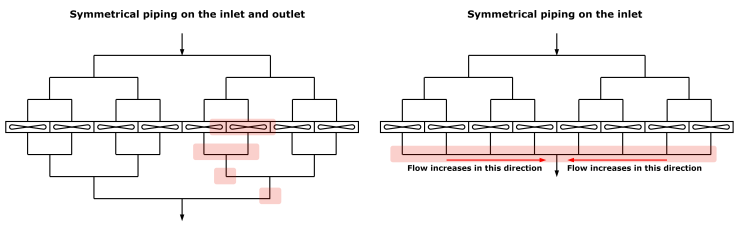
The preceding chapter underscored the significance of flow in ammonium bisulfide corrosion. This aspect holds particular importance in REAC systems, including inlet/outlet manifolds and REAC tubes, where high turbulence in two-phase flow can precipitate rapid metal degradation under theoretically “safe” and “non-corroding” conditions. To mitigate this issue, typical designs for REAC loops incorporate what is known as a “balanced piping” configuration (see Figure 4). The ideal balanced system should ensure equal flow distribution and uniformity in deposition/fouling and sour water corrosion along the REAC tubes and manifolds. While perfect distribution may not be achievable in practice, striving for balance significantly improves system performance compared to unbalanced setups. As a general design principle, both inlet and outlet piping should be balanced. However, in certain scenarios, a balanced inlet system may be coupled with an unbalanced outlet (see Figure 4). This configuration fosters flow-accelerated sour water corrosion along the gathering manifold (where flow intensifies toward the primary outlet) and in manifold regions opposite to outlets, particularly in the final banks where vapor-liquid impingement is likely to occur. Nevertheless, it’s worth noting that flow-accelerated sour water corrosion may still manifest in a balanced system, albeit to a lesser extent, especially when both inlet and outlet piping are balanced.
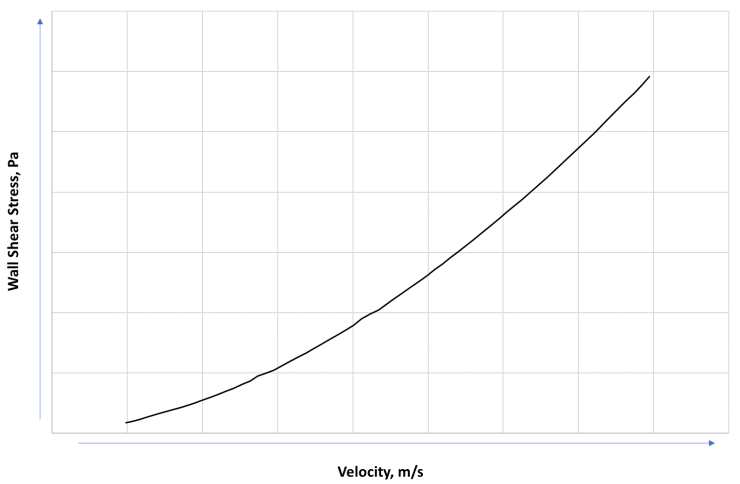
Accurate assessment of flow and Wall Shear Stress (WSS) is of paramount importance for proper evaluation of sour water corrosion risk and establishment of meaningful CMLs (Condition Monitoring Locations – formerly TMLs – Thickness Monitoring Locations). The traditional rule of thumb regarding flow velocity, which suggests a maximum of 6.1 m/s (20 ft/s) for REAC tubes and inlet, and 3.0 m/s (approximately 10 ft/s) on the outlet manifold, may prove overly optimistic and insufficiently conservative, particularly as the concentration of NH4HS exceeds 2 wt.%, H2S partial pressure is high, and cyanides are present. The API normative document governing REAC design explicitly states that simple velocity rules are inadequate for REAC design and establishing IOWs.10 Over two decades ago, it was recommended to use wall shear stress as a proxy for velocity (see Figure 5).11 Extensive studies on sour water corrosion have demonstrated that WSS serves as a much more reliable reference parameter when describing ammonium bisulfide corrosion, particularly when transitioning between laboratory experiments and field conditions, and vice versa.11
The example relation between WSS and NH4HS concentration, as depicted in Figure 6, clearly demonstrates that even at low NH4HS concentrations, corrosion rates may reach nearly 0.5 mm/year (20 mpy) at certain WSS levels.9
Figure 6 Example relation between WSS, NH4HS concentration and corrosion rate. after 9
Impact of cyanide ions
One of the crucial parameters influencing sour water corrosion, yet still not fully investigated, is the impact of cyanide ions (CN-) concentration. Hydrogen cyanide (HCN) forms through catalytic cracking reactions of nitrogen-containing compounds present in side-cuts processed in hydrocracking units. The exact routes of HCN formation remain unknown due to the complexity and variety of nitrogen-containing compounds found in hydrocracking unit feed.12 Nevertheless, the formed HCN dissolves in water (after water wash) and dissociates to form CN- ions. These ions are responsible for intensifying ammonium bisulfide corrosion through their reaction with the protective iron sulfide layer, forming a soluble ferrocyanide complex. Additionally, they contribute to the phenomenon of wet H2S cracking.
The industry-wide rule of thumb sets CN- limits in sour water at 20 ppm, a guideline partially validated by a few laboratory exercises.5 These exercises observed that an increase in cyanide levels from 0 ppm to 17 ppm did not significantly raise the corrosion rate of carbon steel. However, a notable contrast emerged when higher concentrations of CN- were present, notably at 40 ppm.5 Additionally, Horvath et al.5 noted an intriguing behavior among corrosion-resistant alloys such as 316L or Alloy 825. These alloys exhibited poor resistance - almost at the same corrosion level as carbon steel - when CN- concentrations fell below 20 ppm. Evidently, CN- ions can readily destabilize the passive oxide layers on corrosion-resistant alloys, leading to rapid corrosion. Such findings contribute to a more complex and perplexing scenario. Consequently, it’s unsurprising that API RP 932-B normative does not specify any particular limits for cyanide concentration. Therefore, it is advisable to approach all guidelines or rules-of-thumb pertaining to CN- concentration with caution.
Temperature
The impact of temperature on ammonium bisulfide corrosion is far more complex than commonly believed. While it’s intuitive to expect that corrosion rates would increase with rising temperatures, as per the standard chemical reaction-temperature relation, the actual magnitude of these changes varies depending on other parameters such as the partial pressure of H2S and NH3. In cases of high H2S partial pressure, the corrosion rate for both carbon steel and corrosion-resistant alloys (CRAs) increases with temperature.6 The extent of this increase is further influenced by NH4HS concentration and flow rates. When NH3 partial pressure is significantly higher than H2S partial pressure, the situation becomes even more intricate as temperature changes affect the equilibrium of Equation 3 and the dissolution/dissociation of H2S and NH3. Additionally, the presence of cyanides further complicates matters, as an increase in temperature alters their dissolution/dissociation equilibrium as well.5 6
Hydrocarbons presence
The protective effect of hydrocarbon phases against water-type electrochemical corrosion, such as in the case of ammonium bisulfide corrosion, is well-documented and recognized, particularly in crude-water systems. Typically, heavier crudes containing high levels of resins and asphaltenes tend to form a protective layer against water ingress, thereby reducing the corrosion rate caused by CO2/H2S/H2O. Similar effects have been noted in sour water corrosion scenarios. In various sections of REAC, we do not exclusively encounter 100% liquid water, but rather mixtures with varying hydrocarbon contents. Observations indicate that an increasing presence of hydrocarbon fractions, typically up to 25-40 vol%, results in a degree of protection for carbon steel.4
The effectiveness of hydrocarbon protection is closely linked with flow regime dynamics. Turbulent flow, for instance, is expected to enhance hydrocarbon protection due to the proper distribution of hydrophobic hydrocarbon molecules along the pipe circumference, whereas laminar or stratified flow may not yield the same level of protection.7
Materials
Typically, REAC systems incorporate a range of materials, spanning from carbon steel to corrosion-resistant alloys (CRAs). Stainless steels are commonly utilized upstream of the REAC, particularly when concerns such as high-temperature hydrogen attack (HTHA) and/or sulfidation arise. For effluent cooler tubes, materials such as carbon steel or corrosion-resistant alloys (CRAs) are preferred, excluding standard austenitic stainless steels which are susceptible to chloride-stress corrosion cracking (Cl-SCC).10 While the generic alloys classification provided by API norms offers guidance on resistance to ammonium bisulfide corrosion, it should be utilized cautiously due to the multi-parametric interference of various factors discussed in earlier chapters.
As a result, it is challenging to offer even a general recommendation regarding material selection for specific sections of the REAC and downstream loops without conducting a detailed analysis of process conditions. Table 2 provides a generic summary of available data on material behavior in sour water conditions.
Table 2 General rules for MoCs in REAC loop. NOTE: these are generic guidelines for advisory purposes only.
| Process area | Material | Comments | Reference |
|---|---|---|---|
| Inlet piping (>200°C, before water wash). | Cr-steels, series 300 austenitic steels | To reduce the potential for sulfidation and HTHA | 10 |
| Inlet piping after water wash | Carbon steel, Aloy 825, 300 series austenitic steels with Mo. | 300 series stainless steels may be prone to Cl-SCC, however with proper water wash still may provide reasonable performance. No significant impact of chlorides at high H2Spp was reported in laboratory studies. | 4,10 |
| REAC tubes | Carbon steel, 300 series austenitic steels with Mo, Alloy 825, Duplex 2205 and Super Duplex 2507, Special alloys. | • It is recommended to perform specific corrosion modelling. • Consider the impact of CN-. • High NH3pp may cause rapid degradation of 300 stainless steels and increase corrosion of other CRAs except C-276 which behaves exceptionally. Duplex/Super duplex perform well at very high concentrations of NH4HS. Attention should be given to restoring the duplex microstructure after welding. Hydrogen embrittlement was reported on duplex steels. | 5,6,10,14,15 |
| Downstream piping to REAC, separators etc. | Carbon steel, Alloy 825 clad. | It is recommended to perform specific corrosion modelling. Consider impact of CN-. | 13 |
Tools
Below is a user-friendly calculator to estimate sour water corrosion of carbon steel.
Calculator
NOTICE: The provided tool is for advisory purposes only. Corrology Innovations Limited and its employees shall not be held liable for any damages, resulting from the use or inability to use the information provided.
References
This Article has 15 references.
1:American Petroleum Institute Recommended Practice – API RP 571, latest edition
2:EFC Pub no. 46, “Corrosion in Amine Treating Units” 2nd edition by J. van Roij, Woodhead Publishing, 2022
3:S.M. Al-Ghamdi, O.S. Al-AbdulGader, M.A. Davidson - Corrosion Control of a Hydrocracking Unit Debutanizer Overhead System - NACE Corrosion Conference 2016, paper no. 7273
4:R.J. Horvath, M.S. Cayard, R.D. Kane - Prediction And Assessment Of Ammonium Bisulfide Corrosion Under Refinery Sour Water Service Conditions - NACE Corrosion Conference 2006, paper no. 6576
5:R.J. Horvath, S. Srinivasan, V.V. Lagad, R.D. Kane - Prediction And Assessment Of Ammonium Bisulfide Corrosion Under Refinery Sour Water Service Conditions — Part 2 - NACE Corrosion Conference 2010, paper no. 10349
6:S. Srinivasan, K.M. Yap, R.J. Horvath, R.D. Kane - Prediction and Assessment of Ammonium Bisulfide Corrosion Under Refinery Sour Water Service Conditions – Part 3 - NACE Corrosion Conference 2017, paper no. 8929
7:S. Srinivasan, V. Lagad, R.D. Kane - Evaluation Of Prediction Tool For Sour Water Corrosion Quantification And Management In Refineries - NACE Corrosion Conference 2009, paper no. 09337
8:American Petroleum Institute Recommended Practice – API RP 581, latest edition
9:V.V. Lagad, K.M. Yap, S. Srinivasan - Effect of Flow on Corrosion - Experimental Findings and Empirical Correlations - NACE Corrosion Conference 2012, paper no. 1194
10:American Petroleum Institute Recommended Practice – API RP 932-B, latest edition
11:S. Srinivasan, R.D. Kane, D. Moor - Prediction System for Sour Water Corrosion Quantification and Management in Refineries - Eurocorr 2007, paper no. 1241
12:S.H. Frisbie, D.K. Nelsen, S.S. Croce - Cyanide Generation, Corrosion, Treatment, And Discharge At A Petroleum Refinery - NACE Corrosion Conference 1998, paper no. 584
13:M.S. Cayard, W.G. Giesbrecht, R.J. Horvath, R.D. Kane, V.V. Lagad - Prediction Of Ammonium Bisulfide Corrosion And Validation With Refinery Plant Experience - NACE Corrosion Conference 2006, paper no. 6577
14:H. Iwawaki, K. Toba - Corrosion Behavior of Steels in Concentrated NH4HS Environments - NACE Corrosion Conference 2007, paper no. 7576
15:K. Picker, J. Eidhagen, J. Howing - Corrosion Behavior of UNS N08935 In Refinery Sour Water Service - AMPP Corrosion Conference 2021, paper no. 16831