Sulfuric Acid Corrosion
General Information
Sulfuric acid has been well-known for centuries, with the earliest documented information dating back to the Sumerian period (2000-3000 years BC). Its significance in modern times, particularly during the 19th and 20th centuries, led to numerous extensive studies on its chemical properties, such as reactivity in processes like electrophilic aromatic substitution, as well as its corrosion reactions with common construction materials such as carbon steel, stainless steels, and high chromium and molybdenum alloys.
Corrosion of carbon steel and major austenitic stainless steels like 304L and 316L has been extensively studied over the last 60-70 years. These studies have provided a relatively good understanding of the correlation between temperature, velocity, acid concentration, and corrosion rate for the respective alloys.1 ,2 ,3 ,4 The development of new Corrosion Resistant Alloys (CRAs) such as Alloy B-2, B-3, Alloy-20, and Alloy 31 has virtually eliminated or at least minimized problems associated with sulfuric acid corrosion in refining and other industries.
The main challenge in operating with sulfuric acid in many applications arises during dilution, injection, or mixing, where the concentration of the acid may fluctuate from nearly 98% to nil. Only a few expensive alloys can handle situations where sulfuric acid changes its properties from a reducing to an oxidizing system and vice versa. The presence of contaminants like ferrous ions and halides may exacerbate this effect and accelerate the degradation of steels and alloys that are virtually immune to corrosion.
In the last decade, attention has been focused on the use of polymeric materials such as cross-linked low-density polyethylene (X-LDPE) and high-density polyethylene (HDPE) for sulfuric acid storage tanks. However, at high concentrations of sulfuric acid and exposure to sunlight, the resistance of plastic materials may change, leading to unpredictable degradation of pipes or vessels.
Given the wide range of applications for sulfuric acid, it is challenging to compile an exhaustive list of problematic areas. Typical locations for H2SO4 corrosion are listed in Table 1.
Table 1 Examples of typical locations of H2SO4 corrosion.
| Process Unit | H2SO4 corrosion impacted areas |
|---|---|
| Condensate Polishing Unit (CPU) Wastewater Treatment Plant (WTP) | Concentrated acid injection skid, as a whole system with particular focus on: • Acid injection quill • Pipe segment from injection quill to first check valve • Small bore piping in injection skid (high velocities) |
| Utility & Storage | • Concentrated acid storage tank • Intermediate storage tanks • Outlet from acid pumps • Elbows and tees in concentrated acid transportation pipelines |
| H2SO4 Alkylation Unit | • Contactor (mixing section) • Spent acid lines from acid settlers and spent acid tank |
Mechanism
Diluted sulfuric acid (approximately 70% concentration) will react with iron in a simple manner according to Equation 1, producing hydrated ferrous sulfate and gaseous hydrogen.

Iron (II) sulfate (FeSO4) readily dissolves in diluted acid, resulting in rapid corrosion of carbon steel (as shown in Equation 2). However, as the acid concentration increases to about 60-70%, the solubility of FeSO4 reaches its minimum, thereby reducing the corrosion rate. The situation becomes more complicated when the acid concentration exceeds 70-80%. At this concentration, the solubility of iron (II) sulfate (FeSO4) in sulfuric acid begins to increase, leading to an increase in the corrosion rate. However, the corrosion rate falls after reaching approximately 90% concentration (as depicted in Figure 1), consequently reducing the corrosion rate of carbon steel.
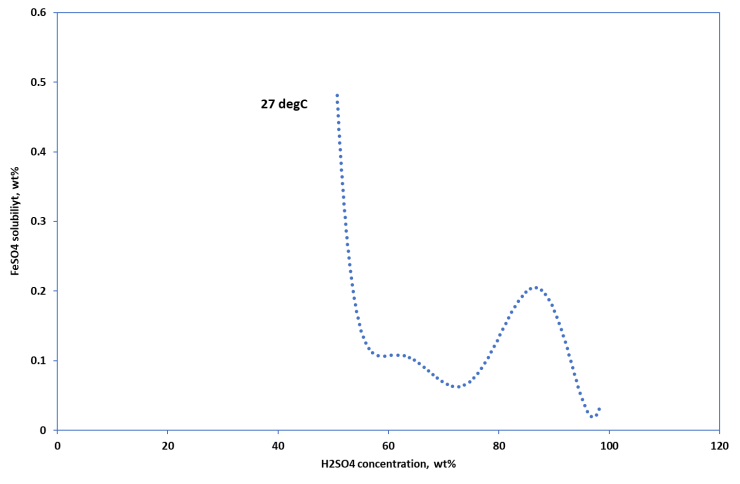
Note that this observation is only valid for stagnant conditions or very low flow velocity (near zero). Under flow conditions (even if no turbulence is present), the protective layer may be easily removed from the metal surface, intensifying corrosion processes (refer to Figure 2). The temperature factor, as shown in Figure 2, plays an important role in determining the H2SO4 corrosion rate. Detailed correlations between process parameters and H2SO4 corrosion rate will be discussed in the next chapters.
Figure 2 Example Impact of velocity and temperature on carbon steel corrosion in conc. H2SO4 (100%).after 5
Key Variables
The corrosion of carbon steel by sulfuric acid is primarily determined by a combination of three parameters:
- temperature,
- acid concentration,
- flow. Additionally, presence of oxidizing contaminants may also have detrimental effects on material’s resistance, especially when high-alloy corrosion resistant materials like Alloy B-2 or B-3 are used.
Temperature and Acid Concentration
These two parameters are typically discussed jointly when describing the behavior of metallic materials in sulfuric acid. Carbon steel remains the most common material for concentrated sulfuric acid storage and transportation piping, usually analyzed separately from other CRAs. This distinction stems from the in-depth studies on carbon steel behavior conducted over six decades ago by renowned researchers including Sheldon Dean, Fontana, and others.1
The behavior of carbon steel in sulfuric acid has been described in detailed mathematical form by Sheldon Dean (Equation 3), which reasonably mimics the corrosion of carbon steel under actual field conditions.5 ,7 API RP 581 tables in Annex 2B for determining sulfuric acid base corrosion are mostly based on the Sheldon Dean equation and can be used for relatively accurate prediction of carbon steel corrosion rates in concentrated sulfuric acid (60-100%).6 (Figure 3)

Where: CS CR = carbon steel corrosion rate (mm/y); T = temperature (K); d = pipe ID (m), v = velocity (m/s); g = density (kg/m3); μ = viscosity (cP); W = solubility of FeSO4 in H2SO4 (wt%), Wbulk = concentration of FeSO4 in the bulk H2SO4 (wt%).
The situation becomes more complex when dealing with corrosion-resistant alloys. Typically, CRAs exhibit a notable degree of immunity to sulfuric acid as a general principle. However, similar to carbon steel, CRAs may experience some fluctuations in corrosion resistance under varying concentrations of H2SO4 and operating temperatures.
Figure 3 Example of Temperature-Acid Concentration-Corrosion Rate relations for carbon steel (stagnant conditions, color numbers represent acid concentration in wt.%). after 6
The most typical and well-described example of a CRA with swinging passivity is Alloy 20 (UNS N08020). It has been reported that deaerated sulfuric acid at concentrations of about 60-70%, at elevated temperatures, may cause accelerated corrosion of Alloy 20.7 ,8 This phenomenon is usually attributed to the loss of the passive layer and the effect of the swinging properties (reducing/oxidizing) of H2SO4 at concentration of 60-80% and elevated temperature. The deficiency of oxygen prevents the reinstatement of the passive layer, eventually leading to high corrosion rates. It is important to highlight that temporary diminishment of corrosion resistance is not exclusive to Alloy 20. Austenitic stainless steel (316L) or alloys like Hastelloy G or Hastelloy C-4 , may experience similar phenomena.8
Excluding these relatively incidental cases with sudden loss of passivity, most CRAs tested in H2SO4 environments (both diluted and concentrated) demonstrate solid performance, as described by their respective iso-corrosion diagrams (Figure 4). The iso-corrosion diagrams should be treated with some caution because the data used typically comes from static immersion tests. This caution is especially important in the case of new or less popular alloys. Popular CRAs like 316L, 304L, Alloy 20, and alloys from the Hastelloy group have been thoroughly tested in both static and dynamic conditions over the last few decades, resulting in reasonably accurate corrosion resistance data.
MMore detailed information about the performance of CRAs in sulfuric acid, as well as simple corrosion rate calculators, is presented in the Materials & Tools sections.
Flow
Carbon steel exposed to concentrated acid is highly sensitive to flow. Figure 5 illustrates the behavior of carbon steel in the presence of 98% sulfuric acid, which is the most common acid used in bulk storage and distribution systems within process plants.6 Given carbon steel’s inability to handle an acid flow rate exceeding 1m/s, its usage is primarily restricted to storage tanks or, in certain cases, to pipelines with an inner diameter greater than 2 inches, where the flow rate of concentrated sulfuric acid remains below 1 m/s.11 The velocity boundary will be significantly reduced for elevated temperatures, for example, when the temperature increases above approximately 25°C (77°F). Moreover, it is recommended to use more precise flow modeling with Wall Shear Stress (WSS) as the controlling factor for flow. It is a known phenomenon that at the same velocities, the actual shear forces near the wall may vary significantly (e.g., plain wall vs. weld protrusion), leading to “unexpected” failures of carbon steel pipelines.12
The first-choice Corrosion Resistant Alloys, such as 316L and Alloy 20, offer far better resistance to fluid turbulences than carbon steel. Figure 6 illustrates the impact of sulfuric acid (95% and 98%) flow velocities on 316/316L corrosion within a temperature range of approximately 30-71°C.6 ,8 It is evident that operating of concentrated sulfuric acid (95-98%) with 316/316L material, the relatively safe flow velocities are below 1.8 m/s at 30°C.
For more detailed information about the behavior of carbon steel and CRAs in concentrated sulfuric acid at different temperatures and flow velocities, refer to the Tools section.
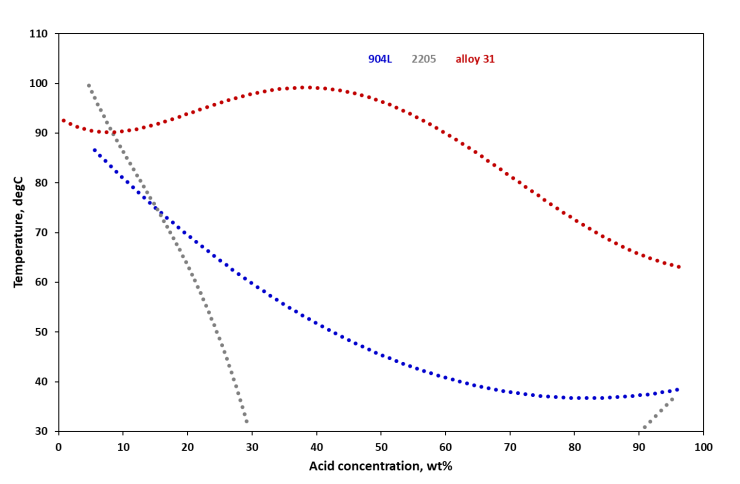
Figure 5 Example of velocity impact on carbon steel corrosion for 98% H2SO4. after 6
Figure 6 Example of 316/316L behavior in conc. H2SO4 (95% and 98%) at different velocities and temperatures. after 6 ,8
Contaminants and other factors impacting material’s behavior in H2SO4
The role of acid contaminants, particularly in concentrated acid, as well as other elements such as post-welding treatment, should not be overlooked when assessing the risk of corrosion in sulfuric acid handling systems. Generally, the presence of dissolved oxygen promotes faster passivation of CRA surfaces and consequently improves corrosion resistance.8 Additionally, the presence of iron ions also positively affects the corrosion resistance of CRAs.8 ,14 Chloride ions, due to their destructive role in passive layer formation, typically cause an increase in the corrosion rate of CRAs even those considered highly immune to sulfuric acid attack, such as Alloy B-3 (see Figure 7).13
Figure 7 Examples behavior of B-3 alloy in diluted sulfuric acid in the presence of Cl- at boiling conditions. after 13
Another interesting fact is the role of surface condition in determining the corrosion resistance of 316 and Alloy 20 materials. The effect of surface treatment (dry/wet grinding) has been shown to have a positive effect on the behavior of 316 stainless steel.8 It is believed that the welded surface of either 316 or Alloy 20, if not post-weld treated (grinding/pickling/passivation), may not have a chance to be properly re-passivated by interaction with oxygen from the air, eventually leading to accelerated corrosion. Inspection of welded CRA surfaces should focus on unexpected surface irregularities such as arc strikes and slag, which, if left untreated, may serve as initiation points for corrosion.
Materials
Carbon steel remains the primary construction material for systems handling concentrated sulfuric acid (97-98%) in many industries. The behavior of carbon steel in concentrated acid is well-known and well-defined, as discussed in earlier chapters. It is relatively easy and accurate to predict its behavior under stagnant and flowing acid conditions. Normative documents such as AMPP (formerly NACE) SP0391 and SP0294 provide reasonable guidance for handling concentrated sulfuric acid in carbon steel systems.11 ,15 Guidelines incorporated in these standards represent a conservative approach in setting boundaries for acid velocities, concentrations, material allowances, and operating temperatures. The only critical comment to be added for these standards is the need for a more careful approach to velocity limits, emphasizing the role of Wall Shear Stress (WSS).12
Stainless steel 316/316L is traditionally the second most popular material of construction used in handling concentrated sulfuric acid. Typically, it is employed for acid pipelines downstream of acid pumps, injection skids, and distribution pipelines with inner diameters of ≤4 inches. The corrosion resistance of 316L material has been extensively studied for several decades, including the fundamental work of Fontana.4 Published iso-corrosion diagrams for 316 stainless steel (Figure 8) are well-established and accurate. However, users must bear in mind that 316 stainless steel may transition from a passive to an active state, resulting in a very high corrosion rate. Attention should also be given to post-weld inspection and treatment, which may be required to reinstate the protective passive layer.
Figure 8 Example of 316 stainless steel iso-corrosion diagrams. after 4
Alloy 20 (UNS N08020) ranks as the second most popular material among common CRAs used for concentrated sulfuric acid service. It exhibits high corrosion resistance to sulfuric acid across the entire concentration range (from 0 to 100%) and temperature range from 50°C to the boiling point, as depicted by 0.1 mm/y iso-corrosion diagrams.8 ,10 When utilizing Alloy 20, particular attention should be paid to operating temperatures, especially in components like injection quills in acid dilution spools and pipe segments adjacent to the nearest check-valve. In cases of periodic dosing, there is a possibility that during shutdown periods, the acid trapped inside the injection quill and nearby piping will slowly dissolve in water, causing temperature excursions above 50°C. This could eventually lead to accelerated degradation of Alloy 20, as it may corrode at a rate of up to 0.5mm/y, especially when the concentration surpasses the 60-70% range. Changes in the passive/active properties of Alloy 20 are also documented; therefore, it is advisable to consider re-passivating welded surfaces. Leaving surfaces in an “as-welded” condition may induce an “active state” and result in rapid corrosion of Alloy 20.12
Other CRAs such as 904L (UNS N08904), Hastelloy C-22 (UNS N06022), C-276 (UNS N10276), Hastelloy B-2, and B-3 (UNS N10665 and UNS N10675 respectively), along with others, exhibit high resistance to sulfuric acid across the entire concentration range (0-100%), as illustrated in Figure 9.
Figure 9 Examples of corrosion behavior of B-3 and C-276 in concentrated H2SO4 at various temperatures, immersion tests. after 12 ,16 ,17 ,18 ,19
Tools
Below is a user-friendly calculator to estimate the sulfuric acid corrosion of carbon steel and popular CRAs.
Calculator
NOTICE: The provided tool is for advisory purposes only. Corrology Innovations Limited and its employees shall not be held liable for any damages, resulting from the use or inability to use the information provided.
References
This Article has 19 references.
1:M.G. Fontana - Corrosion chapter - Ind. Eng. Chem., 43, 8 (August 1951), pp: 65A-68A.
2:W.G. Whitman, R.P. Russell, C.M. Welling, J.D. Cochrane Jr. - The effect of velocity on the corrosion of steel in sulfuric acid - Ind. Eng. Chem., 15, 7 (July 1923), pp: 672- 676.
3:W.G. Whitman, R.P. Russell - The acid corrosion of metals – effect of oxygen and velocity - Ind. Eng. Chem., 17, 4 (April 1925), pp: 348-354.
4:M.G. Fontana - Corrosion chapter - Ind. Eng. Chem., 44, 3 (March 1952), pp: 89A-98A.
5:Z. Panossian, N.L. de Almeida, R.M. Ferreira de Sousa, G. de Souza Pimenta, L.B. Schmidt Marques - Corrosion of carbon steel pipes and tanks by concentrated sulfuric acid: A review - Corrosion Science 58 (2012) 1–11.
6:American Petroleum Institute Recommended Practice – API RP 581, latest edition.
7:P.F. Ellis II, S. Srinivasan, K.M. Yap, R.J. Horvath - Prediction and Assessment of Corrosion in Sulfuric Acid Alkylation Units - NACE Corrosion Conference 2013, paper no. 2535.
8:The Corrosion Resistance of Nickel-Containing Alloys in Sulfuric Acid and Related Compound - Nickel Institute – INCO Technical Paper no 1318, 1983.
9:L. Paul - Summary of some nickel alloys used in chemical production involving hydrochloric and sulfuric acids - NACE Corrosion Conference 2012, paper no. 1443.
10:R. Francis, G. Byrne - The performance of Z100 (UNS s32760) Superduplex stainless steel in sulphuric acid - NACE Corrosion Conference 2006, paper no. 6216.
11:NACE/AMPP - Materials for the Handling and Storage of Commercial Concentrated (90 to 100%) Sulfuric Acid at Ambient Temperatures - SP0391-2016
12:S. Kus, P.F. Ellis II, S. Srinivasan, M. Qreis - Behavior of Steels and Alloys in Concentrated Sulfuric Acid Under Different Flow Regimes – New Perspectives - NACE Corrosion Conference 2016, paper no. 7610.
13:R.B. Rebak - Corrosion Rate of Nickel Based Alloys Measured by Electrochemical Techniques and Immersion Tests. Effect of Temperature, Alloying Elements and Electrolyte Composition - NACE Corrosion Conference 1999, paper no. 219.
14:H. Alves, H. Werner, D.C. Agarwal - Corrosion performance and applications of alloy 31 and alloy 59 in sulfuric acid media - NACE Corrosion Conference 2006, paper no. 6222.
15:NACE/AMPP - Design, Fabrication, and Inspection of Storage Tank Systems for Concentrated Fresh and Process Sulfuric Acid and Oleum at Ambient Temperatures - SP0294-2006.
16:A. Mishra - Materials Performance in an Oxidizing Acid and Corrosive Solution containing Oxidants - NACE Corrosion Conference 2019, paper no. 12991.
17:E.L. Hibner, L.E. Shoemaker - A practical guide to use of nickel alloys for sulfuric acid service - NACE Corrosion Conference 2006, paper no. 6225.
18:D. Niespodziany, R. Behrens, M. Wolf, H. Alves - Characterization of novel high performance material UNS N08034 - NACE Corrosion Conference 2019, paper no. 13156.
19:Y. DAIGO, K. SUGAHARA - Corrosion Properties of N06044 Alloy in Several Kinds of Acidic Solutions - NACE Corrosion Conference 2017, paper no. 9052.