Amine Unit
Reducing sulfur emissions is a crucial goal for every refinery, driven by stringent environmental regulations and the need to minimize air pollution. Hydrogen sulfide (H2S), a significant contributor to sulfur emissions, is generated during various refining processes, including hydroprocessing and cracking. The amine unit serves as the primary stage for removing H2S, along with other sulfur-containing compounds such as carbonyl sulfide (COS) and carbon disulfide (CS2). Key areas prone to corrosion include equipment such as amine absorbers, regenerator columns with reboilers, heat exchangers, and associated piping, where exposure to hot, rich, and lean amine streams can initiate damage mechanisms. Proper material selection, continuous process monitoring, and effective chemical control are essential to mitigate these risks and ensure reliable operations.
#Amine Corrosion; #Corrosion Monitoring in Amine Units
Unit Operation Description
The primary objective of the amine unit involves the removal of acid contaminants, predominantly H2S, but also addressing CO2, COS, CS2, and others from gaseous hydrocarbon streams. This removal of acidic gases is accomplished through a straightforward absorption-desorption process (refer to Figure 1), employing a range of alkanolamine-based solvents. For in-depth insights into amine reactions, solvent selectivity, and overall process conditions, please consult the Amine Corrosion in Damage Mechanisms section.
Corrosion concerns within the amine unit predominantly stem from Amine Corrosion, Wet H2S Damage (H2 Blistering/HIC/SOHIC/SSC), and NH4HS Corrosion, particularly when sufficient NH3 is present in the treated gas. At times, instances of flow-accelerated corrosion manifest in regions of high turbulence, such as tees, bends, and weld protrusions. This occurrence is notably observed in the hot lean amine stream, especially when surpassing HSAS (heat stable amine salts) limits. Corrosion within the amine unit is well-documented, and extensively described in numerous publications that cover major issues and mitigation measures in both rich and lean amine streams. For further details, please refer to the Amine Corrosion and Monitoring sections.
Potential Damage Mechanisms
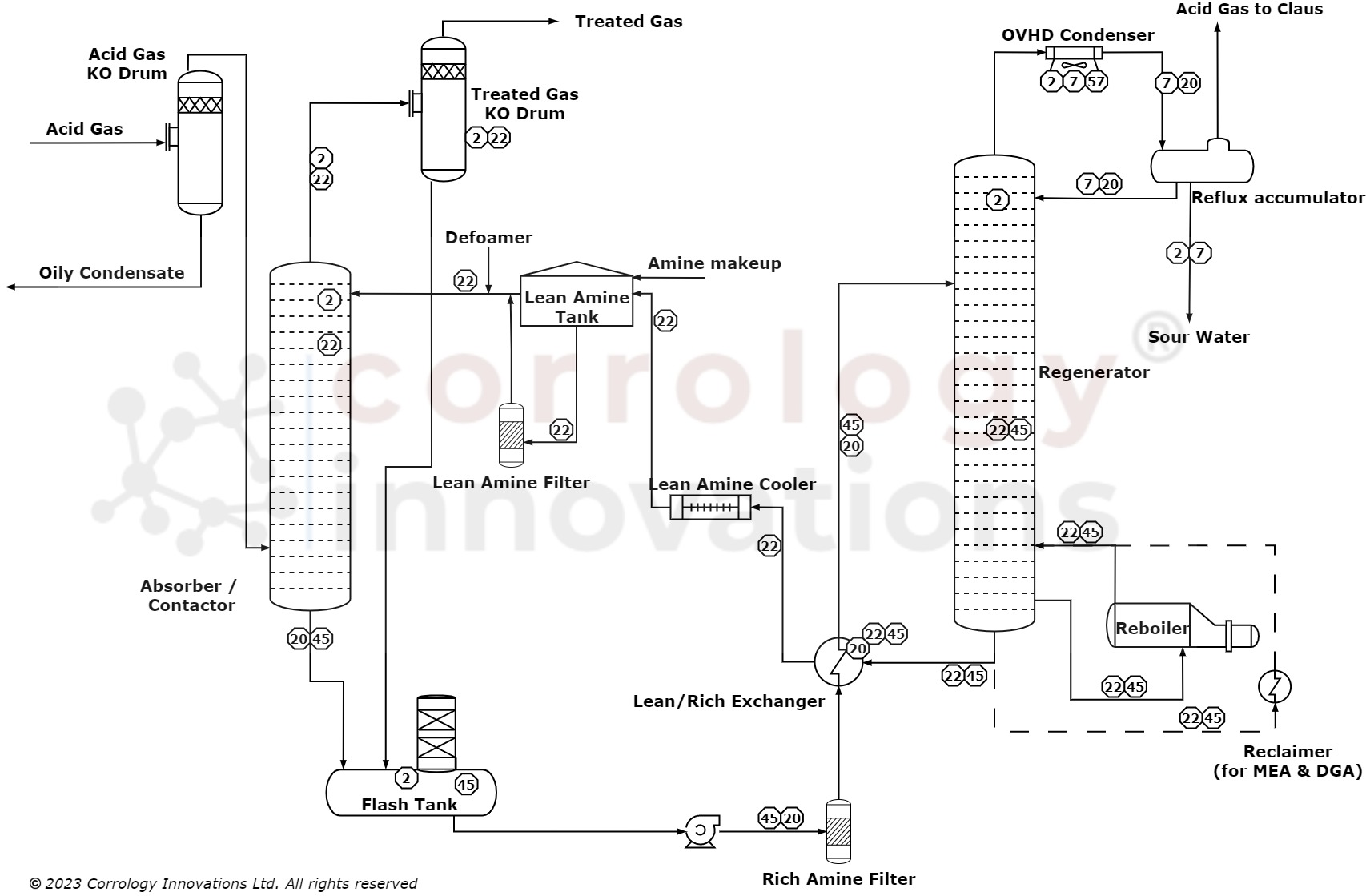
Figure 1 Amine Unit diagram with typical damage mechanisms.after API RP 571
Legend: 2 - Wet H2S Damage (H2 Blistering/HIC/SOHIC/SSC); 7 – NH4HS Corrosion; 20 - Erosion / Erosion-Corrosion; 22 - Amine Stress Corrosion Cracking; 45 – Amine Corrosion; 57 - Titanium Hydriting;
Integrity Operating Windows (IOWs)
The Amine Unit list of Integrity Operating Windows (IOWs) focuses on process parameters that are routinely controlled under standard operating conditions, aiming to reflect real-world practices rather than wishful thinking or a “nice-to-have” approach. As a result, the list does not fully align with API RP 584 recommendations, excluding parameters such as NH₄HS concentration, chloride levels in amine, or the detailed quantification of ionic species in Heat Stable Amine Salt analyses. Although these parameters are important, they are not monitored frequently or consistently, and any changes observed may not represent the actual state of the system.
The categorization of Amine Unit IOWs into Standard or Informational reflects a pragmatic approach, consistent with corrosion rate levels typically observed in industrial operations. No Critical IOWs have been identified, as rapid degradation is not expected upon excursions of the selected parameters. Therefore, operators and other relevant parties have sufficient time to implement mitigating actions—either through process adjustments or by refining and tightening the inspection regime.
Table 1 List of typical IOWs for amine unit. I - Informational IOW, S - Standard IOW, C - Critical IOW
General
| Parameter | IOW | Level | Value | Impact | Mitigation | Notification |
|---|---|---|---|---|---|---|
| KO Drum Liquid Level | I | LOW | N/A | N/A | N/A | N/A |
| HIGH | As per design | • water/HC carryover to absorber • absorber flooding • amine carryover to OVHD and HC to rich amine | • KO draining • set alarm levels | • Shift Control • Proc Eng | ||
| Amine Concentration | I | LOW | Depends on amine type e.g. DEA 20% | • reduced absorption capacity | • increase amine flow rate (erosion-corrosion may start) • top-up with fresh solvent | • Shift Control • Proc Eng |
| HIGH | Depends on amine type e.g. MDEA 50% | • increased viscosity • accelerated solvent degradation | • amine dilution | • Shift Control • Proc Eng | ||
| Heat Stable Amine Salts (HSAS) | S | LOW | No minimum value typically < 0.5-0.7% of amine alkalinity | • steam consumption increases at low salt levels (as suggested in some literature) | • reduce amine replacement/bleed • mix with low-quality amine | • Shift Control • Proc Eng |
| HIGH | Thumb rule: salts < 10% of alkalinity (e.g. < 2% for 20% DEA) | • accelerated corrosion = reduced service life (reboiler, L/R exchangers) | • amine replacement/dilution | • Shift Control • Proc Eng • Corr Eng • Insp Eng | ||
| Acid gas load | S | LOW | Typically no low limits • some minimum load required to maintain FeS protective layer • comonly in range 0.01-0.02 mol/mol< | • economic impact - circulation of unnecessarily high solvent volume | • reduce amine flow rate | • Shift Control • Proc Eng • Corr Eng • Insp Eng |
| HIGH | Max. load determined by solvent type e.g. MEA: 0.3-0.4 DEA: 0.4-0.7 MDEA: 0.45-0.5 | • acid gas flashing and accelerated corrosion | • increase solvent concentration • increase flow rate (will increase erosion-corrosion) | • Shift Control • Proc Eng • Corr Eng • Insp Eng | ||
| Amine flow rate | S | LOW | Thumb rule: > 0.5m/s | • reduced absorption efficiency and acid gas in cleaned product | • increase circulation rate | • Shift controller • Proc Eng • Corr Eng • Insp Eng |
| HIGH | Rule: < 1.5-1.8m/s in rich amine < 1.5-1.8m/s in lean amine (will depend on solvent type and HSAS levels) | • excessive pumping energy demand | • reduce circulation rate • enhance inspection to mitigate erosion-corrosion risk | • Shift controller • Proc Eng • Corr Eng • Insp Eng |
Absorber
| Parameter | IOW | Level | Value | Impact | Mitigation | Notification |
|---|---|---|---|---|---|---|
| Inlet gas T | I | LOW | N/A | N/A | N/A | N/A |
| HIGH | Typically below 35-45°C | • reduced absorption (e.g. H2S present in treated stream) • heavy hydrocarbons enter absorber causing foaming | • increase gas cooling • reduce feed rate | • Shift Control • Proc Eng | ||
| Lean amine inlet T | I | LOW | Based on solvent type e.g. for DEA typically 30-35°C | • increased amine viscosity leading to reduced absorption and amine carryover | • observe ΔT between amine and gas inlet • if >10°C increase amine temp | • Shift Control • Proc Eng |
| HIGH | Based on solvent type typically not higher than 50-55°C | • reduced absorption • H2S in cleaned product | • reduce amine/gas temperature | • Shift Control • Proc Eng | ||
| ΔT between lean amine & gas inlet | I | LOW | 5°C | • condensation of hydrocarbons • amine foaming • hydrocarbon carryover | • reduce lean amine and/or gas inlet temperature | • Shift Control • Proc Eng |
| HIGH | 10°C | • reduced absorption capacity | • adjust amine T to have ΔT at 5-10°C | • Shift Control • Proc Eng | ||
| Absorber Δp | I | LOW | N/A< | N/A< | N/A< | N/A< |
| HIGH | Based on design and solvent type typical assumption 0.7-1.4kPa/tray pressure drop | • absorber flooded • amine carryover | • check/reduce reboiler duty • reduce amine flow or/and gas flow | • Shift Control • Proc Eng | ||
| Absorber Level | I | LOW | As per design | • hydrocarbon carryover to rich amine and transfer HC to SRU | • adjust valve operation to maintain liquid level | • Shift Control • Proc Eng |
| HIGH | Per design | • amine carryover | • adjust valve operation to maintain liquid level | • Shift Control • Proc Eng |
Regenerator
| Parameter | IOW | Level | Value | Impact | Mitigation | Notification |
|---|---|---|---|---|---|---|
| Regenerator Δp | I | LOW | As per design | N/A | N/A | N/A |
| HIGH | As per design | • reduced amine regeneration efficiency • potential amine carryover to OVHD system | • correct amine flow rate • correct reboiler duty • check for foaming | • Shift Control • Proc Eng • Corr Eng • Insp Eng | ||
| Regenerator Top T | I | LOW | As per design | N/A | N/A | N/A |
| HIGH | As per design | • over-stripping | • check/correct reboiler duty | • Shift Control • Proc Eng • Corr Eng • Insp Eng | ||
| Regenerator Top p | I | LOW | As per design | N/A | N/A | N/A |
| HIGH | As per design | • high pressure drop in OVHD • potential for excessive flaring | • reduce reboiler duty • check OVHD condensers for plugging | • Shift Control • Proc Eng | ||
| OVHD drum T | I | LOW | Based on specific solvent typically not allowed to go below 20°C | • salt or hydrate formation leading for plugging and excessive flaring | • reduce cooling duty in OVHD exchangers • consider using steam tracing | • Shift Control • Proc Eng |
| HIGH | Based on solvent typically max 60°C | • elevated humidity in OVHD system | • check OVHD condensers | • Shift Control • Proc Eng • Corr Eng • Insp Eng | ||
| Reflux conductivity | S | LOW | N/A | N/A | N/A | N/A |
| HIGH | No fixed range typically max 25-50mS/cm | • high conductivity indicate elevated concentration of NH4HS | • reflux purge • water analysis for determination of NH4HS • corrosion modelling | • Shift Control • Proc Eng • Corr Eng • Insp Eng | ||
| Reboiler steam temperature | S | LOW | Determined by min reboiler duty | • low steam temperature reduces amine reboiling effectiveness | • reduce amine flow rate | • Shift Control • Proc Eng • Corr Eng • Insp Eng |
| HIGH | Max. determined by solvent type typically max 140-145°C | • temp peaks accelerate amine degradation | • reduce steam temperature (e.g. increase de-superheater water flow) • reduce steam pressure | • Shift Control • Proc Eng • Corr Eng • Insp Eng | ||
| Regenerator Top T | I | LOW | As per design | N/A | N/A | N/A |
| HIGH | As per design | • over-stripping | • check/correct reboiler duty | • Shift Control • Proc Eng • Corr Eng • Insp Eng |
Filters
| Parameter | IOW | Level | Value | Impact | Mitigation | Notification |
|---|---|---|---|---|---|---|
| Pressure drop | I | LOW | As per design (typically to allow min 10% of amine flow to be filtered) | • absorber’s fouling and amine foaming | • filter replace/cleaning | • Shift Control • Proc Eng |
| HIGH | As per design | • flow increase may signal filter internal damage and loss of filtration capacity | • filter inspection for internal damages | • Shift Control • Proc Eng | ||
| Flow rate | I | LOW | As per design | N/A | N/A | • Shift Control • Proc Eng |
| HIGH | As per design | • potential internal damage & loss of filtration capacity | • filter inspection | • Shift Control • Proc Eng |