Sulfur Recovery Unit (SRU)
Hydrogen sulfide (H2S), along with other sulfur compounds such as COS, CS2, etc., are byproducts from various refinery processes. Their removal and conversion into elemental sulfur, a valuable commercial product, is crucial not only for economic reasons but, more significantly, for environmental purposes. The sulfur recovery unit, specifically the Claus Sulfur Recovery Unit, assumes a pivotal role in a refinery’s sulfur management. Supported by additional units like tail-gas treating, it enables the refinery to adhere to the highest environmental standards concerning the emission of sulfur-containing gases.
Unit Operation Description
The Claus Sulfur Recovery Unit or simplistic SRU, essentially converts H2S into elemental sulfur through controlled oxidation followed by catalytic conversion (see below for typical reactions occurring in the Claus process). The generic diagram of the SRU is depicted in Figure 1.
\(\ce{2H2S + O2 <=> SO2 + 2H2O}\) (1)
\(\ce{2H2S + SO2 <=> 3S + 2H2O}\) (2)
\(\ce{CHx + SO2 <=> COS / CS2 + H2O}\) (3)
\(\ce{2NH3 + 3O2 -> N2 + 3H2O}\) (4)
The Claus process itself is relatively straightforward. H2S-rich inlet gas is mixed with air and converted to SO2 and water in the burner section, reaching temperatures around 1200°C (2200°F). The resulting hot gases enter the reaction section where reactions 1-4 reach their equilibrium. The heat from these reactions is recovered in a specialized part of the Claus reactor called the waste-heat recovery boiler, producing high-pressure (HP) steam. From the reaction section, gases at temperatures around 370°C (700°F) enter the condenser, further cooling to about 230°C (446°F). Elemental sulfur condenses at this temperature and is removed from the process in liquid form, typically sent to a collection area known as a sulfur-pit. The gas containing uncondensed sulfur, H2S, and SO2 proceeds into catalytic converters (usually 3-4) for further conversion. Ultimately, the final sulfur recovery yield typically reaches around 98%. The gas exiting the Claus unit (tail gas) contains sulfur and sulfur compounds (SO2, SO3, COS, and CS2), which then enters the tail-gas sulfur recovery unit (TGU), not shown in Figure 1. In the TGU, sulfur-containing gases are catalytically converted into H2S, which is subsequently recovered (e.g., in an amine system) and returned to the Claus process. Unreacted tail-gas from the TGU is directed to incineration to convert all remaining traces of sulfur species into SO2, released into the atmosphere thereafter.
Corrosion damage in SRU stems primarily from Sulfidation, wet H2S cracking and diluted Sulfuric Acid Corrosion. Construction materials in the SRU predominantly consist of carbon steel, often marked as HIC-resistant to minimize the potential for wet H2S damage. The high temperature sections of the Claus reactor are typically constructed from carbon teel with refractory lining to withstand temperature up to approximately 310°C / 590°F. Burner sections operating above this temperature utilize austenitic stainless steel 310 (UNS S31000) or preferrable 316L (UNS S31603). The combustion chamber is constructed from carbon steel with refractory lining and anchors made of austenitic stainless steel. Carbon steel material operates satisfactory above acid dew point (>c.a. 120°C / 248°F) and below sulfidation point 230-240°C (446-464°F). Catalytic converters and re-heaters are usually made of carbon steel with refractory lining. Sulfur rundown pipelines are constructed from carbon steel with external jacketing. The primary corrosion concern relates to the potential appearance of weak acidic sour water. Sulfur pit is constructed from concrete (acid-resistant) with heating coils from carbon steel or austenitic stainless steel (316L) or other CRAs like alloy 20 (UNS N08020).
Potential Damage Mechanisms
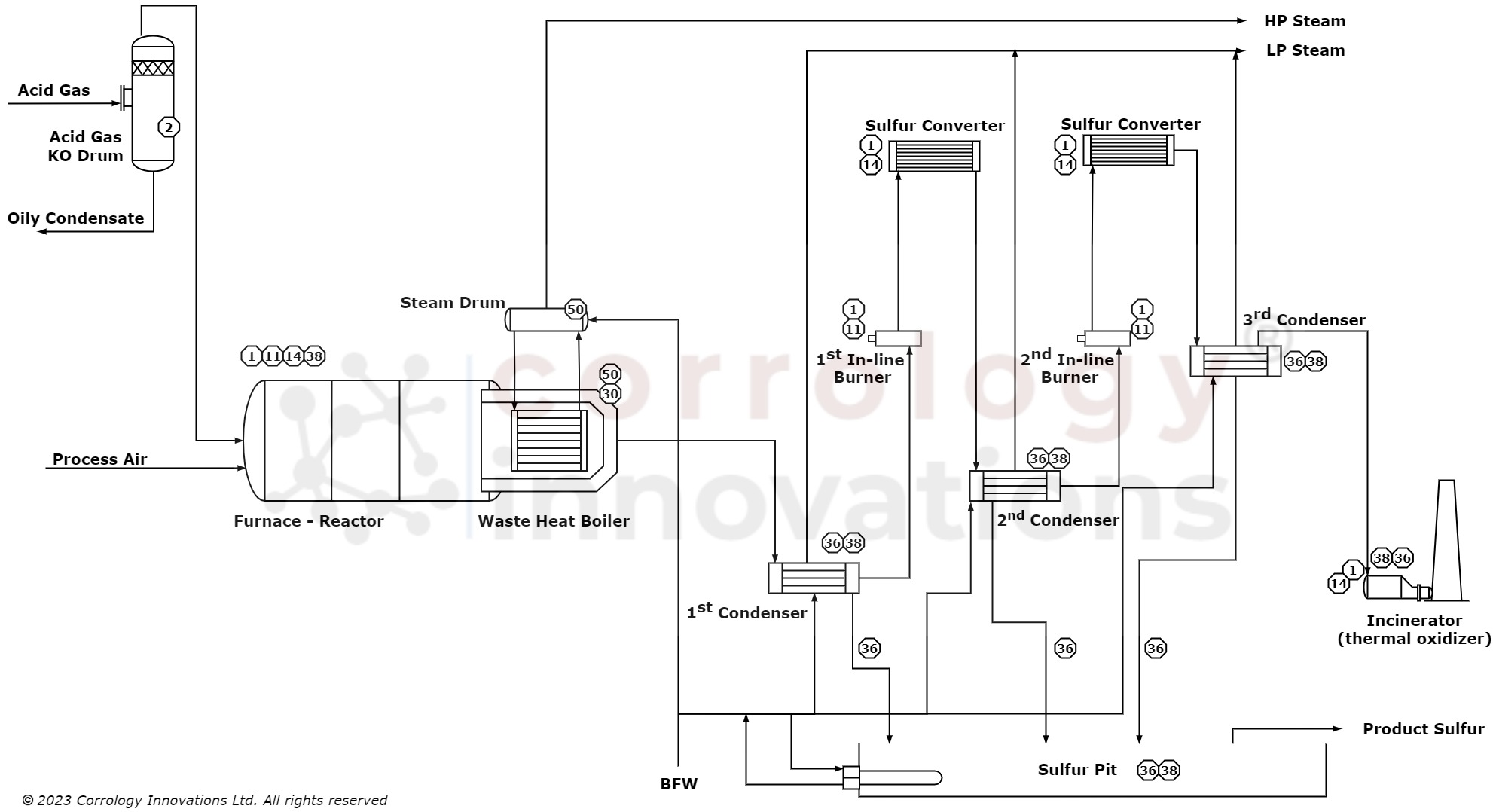
Figure 1 Sulfur Recovery unit (SRU) Unit diagram with typical damage mechanisms.after API RP 571
Legend: 1 - Sulfidation; 2 - Wet H2S Damage (H2 Blistering/HIC/SOHIC/SSC); 11 - Oxidation; 14 - Refractory Degradation; 26 - Steam Blanketing - go to 30; 36 - Sulfuric Acid Corrosion; 38 - Flue Gas Dew Point Corrosion; 50 – Boiler Water-Condensate Corrosion;