Visbreaking Unit (VBU)
Visbreaking is a mild, non-catalytical thermal cracking process, employed to treat high-viscosity products particularly vacuum residue, to produce lower-viscosity fractions. It’s important not to confuse Visbreaking with Thermal Cracking, which usually involves processing atmospheric residue at higher temperatures than Visbreaking, thereby intensifying cracking reactions.
Unit Operation Description
The vacuum residue enters the Visbreaker (VB) heater, which can either internally incorporate heating and soaking sections or perform soaking in a separate vessel known as the ‘soaking drum.’ The role of the soaking section in the VB heater or soaking drum is to prolong the residence time of the feed at the cracking temperature. In the heater, the feed is heated to around 410-430°C (770-806°F) and then enters the soaking section where it remains for a specifically calculated period at temperature slightly higher than in the heater section.
In addition to typical high-temperature damages like creep, thermal fatigue, and carburization, the VB heater may also experience Sulfidation process. This is especially important when refinery is processing a high-thiophenic sulfur crude resulting in consequence a high concentration of thiophenic sulfur in vacuum residue. Thiophene-type sulfur compounds are stable enough to pass through atmospheric and vacuum heaters but may began to degrade at the VB heater operating at high temperatures. The likelihood of observing, for example, Naphthenic Acid Corrosion is relatively low, as most of the corrosive low-molecular acids are expected to have degraded due to the operating temperature (>370°C).
Following soaking, the effluent is typically quenched with cold fuel oil (or gas oil) before reaching the fractionator. In the fractionation column, mildly cracked hydrocarbons are separated into gas, naphtha, gas oil, and residue. Light fractions (gas and naphtha) are condensed in the overhead (OVHD) section and separated into gas and unstabilized naphtha. Part of the unstabilized naphtha returns to the fractionator as reflux, while the remainder enters the naphtha stabilizing column. In the OVHD section of fractionating and stabilizing columns, active damage mechanisms include NH4Cl Corrosion, NH4HS Corrosion and wet H2S cracking.
Gas oil streams and residue (thermal tar) are stripped by steam and then sent to storage. Gas oil is also used to quench the outlet of the VB heater, as mentioned earlier. The hot sections of the fractionator (>c.a. 230°C) are mainly exposed to Sulfidation. For more detailed information about the locations of damage mechanisms, refer to the next section.
Potential Damage Mechanisms
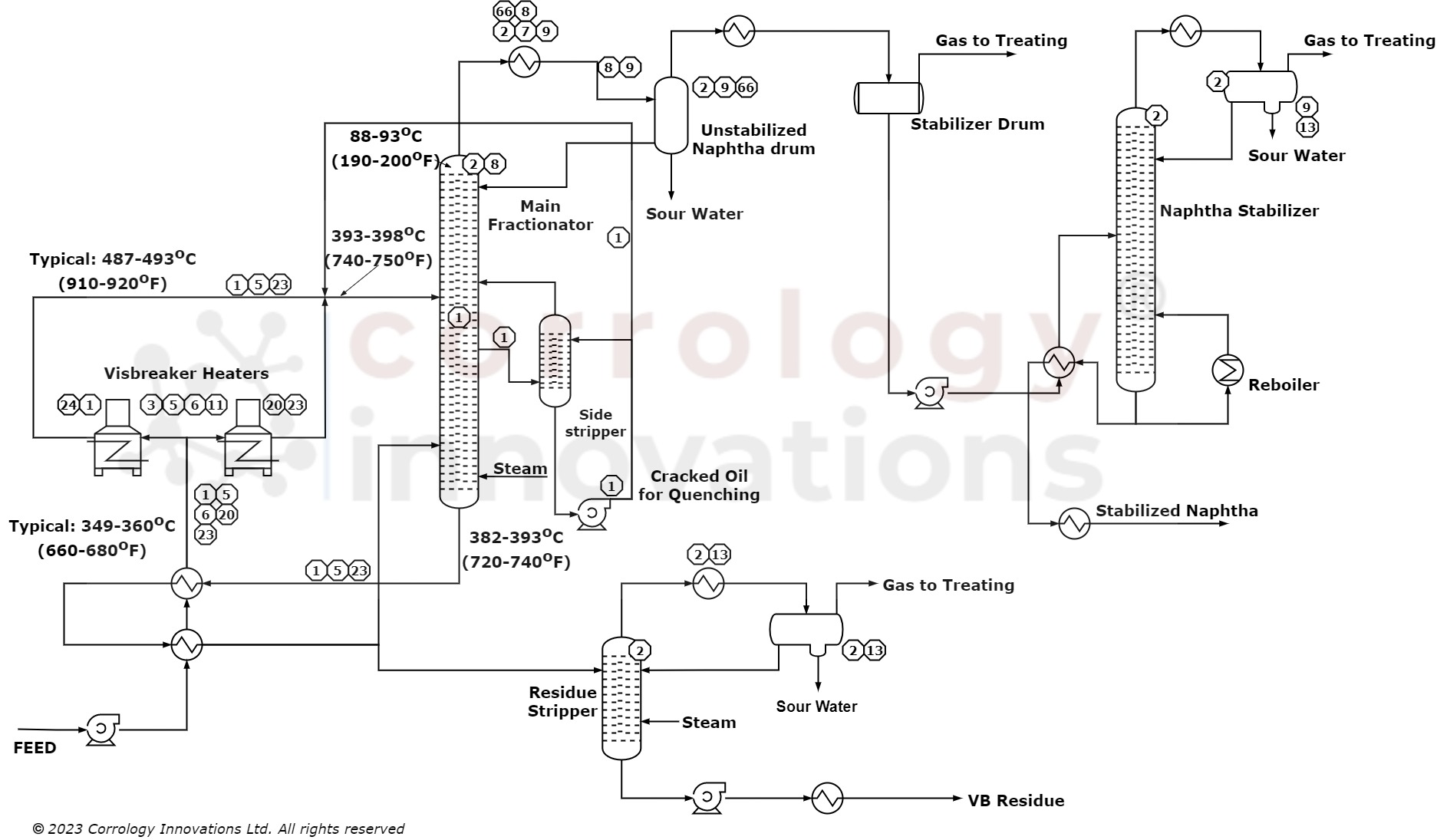
Figure 1 Visbreaking Unit (VBU) Unit diagram with typical damage mechanisms.after API RP 571
Legend: 1 - Sulfidation; 2 - Wet H2S Damage (H2 Blistering/HIC/SOHIC/SSC); 3 - Creep/Stress Rupture; 5 - Polythionic Acid SCC; 6 – Naphthenic Acid Corrosion; 7 – NH4HS Corrosion; 8 – NH4Cl Corrosion; 9 – HCl Corrosion; 11 - Oxidation; 12 - Thermal Fatigue; 20 - Erosion / Erosion-Corrosion; 23 - Chloride SCC; 24 - Carburization; 66 – Aqueous Organic Acid Corrosion;